
Is teamLab Singapore Worth Visiting? An Honest Review (With Kids)

Is teamLab Singapore worth visiting? That was the exact question I asked myself before booking our tickets right after remembering we’ve somehow become a full-blown teamLab travel family.
Between us, we’ve now done three of their exhibits across different countries… all with small children in tow (because clearly we enjoy chaos with a side of immersive art).
So this time, rolling into Singapore, I had slightly higher expectations and a toddler who thinks every glowing room is specifically designed for her.
In this review, I’ll break down whether teamLab Singapore actually lives up to the hype, especially if you’re visiting with kids and wondering if it’s worth the time, money, and snack-bribery required to get through it – particularly if you’re planning a trip to Singapore with kids and looking for easy, engaging activities.
If you’re on a Singapore stopover and looking for something easy but memorable, this fits in perfectly.
And if you’re planning a family trip and want more honest, mum-tested travel tips like this straight to your inbox, don’t forget to sign up for my newsletter.
What is teamLab Singapore?
teamLab Future World Singapore is an immersive digital art experience inside the ArtScience Museum at Marina Bay, where art, technology, and imagination all collide in the most chaotic, kid-distracting way possible.
Instead of standing quietly in front of paintings, you move through a series of interactive rooms filled with moving projections, infinite mirror-like reflections, and responsive light installations that shift as you walk, touch, and explore (or, in our case, as a toddler runs straight through them at full speed).
It’s created by the globally renowned Japanese art collective teamLab, known for building these dreamy, boundary-blurring worlds where you’re not just looking at art, you’re fully inside it.
And while the Singapore version isn’t the biggest of their exhibits, it still delivers that signature “are we inside art or did we accidentally step into a very aesthetic screensaver?” experience that somehow keeps both kids and adults completely mesmerised.

How to get to teamLab Singapore
teamLab Singapore is located inside the ArtScience Museum at Marina Bay Sands, which sounds straightforward… until you’re juggling a pram, snacks, and a child who has suddenly forgotten how legs work.
The easiest way to get there is via Bayfront MRT Station. From the station, follow the signs toward Marina Bay Sands / ArtScience Museum. It’s about a 5–10 minute walk through air-conditioned bliss (a win in Singapore).
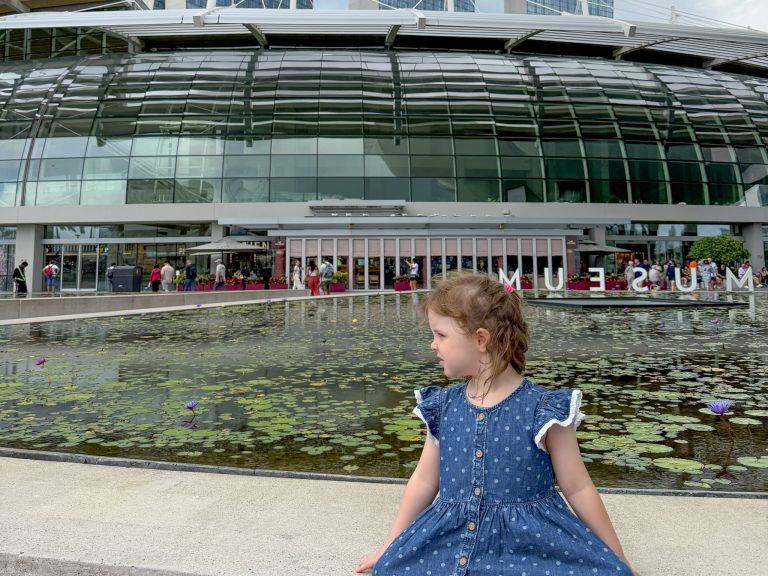
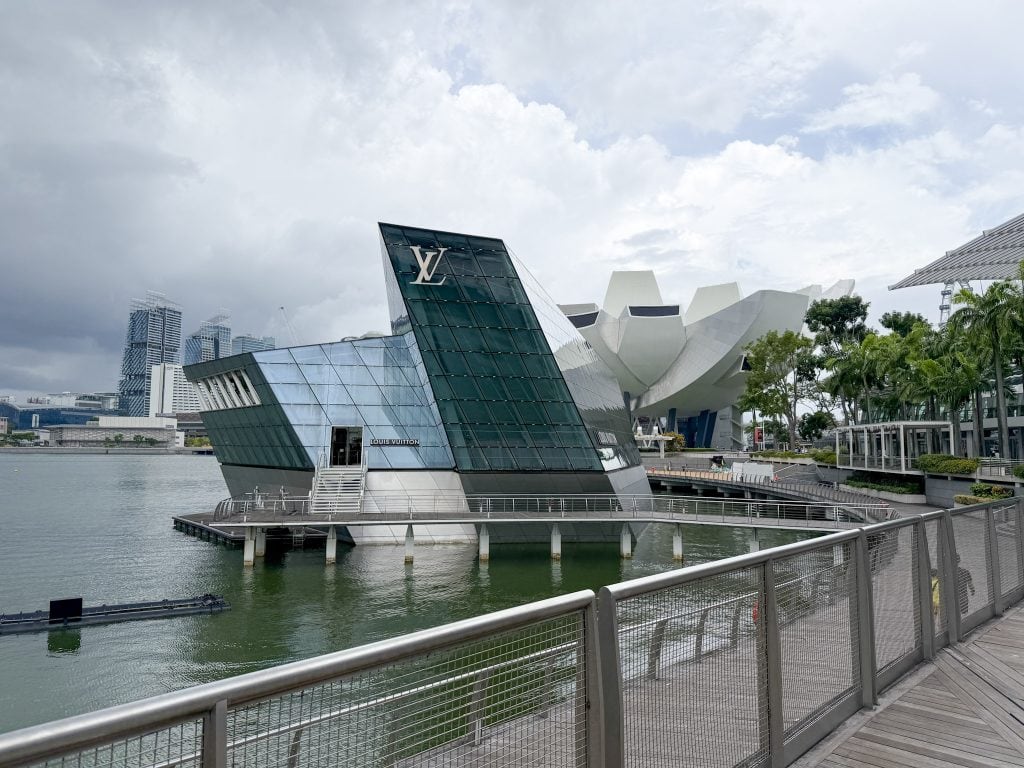
If you’re coming from the Marina Bay Sands mall, just head toward the very recognisable lotus-shaped building which is the museum. Yes, it’s as pretty in real life as it is in photos.
If you’re arriving by taxi, you can be dropped directly at ArtScience Museum. This is by far the least stressful option, especially if someone is mid-snack meltdown however, you do need to remember that Singapore taxis don’t have car seats for kids and babies. Because of this, we prefer to get the train from a safety perspective.
A few practical things to know if you’re visiting with kids:
- Strollers aren’t allowed inside the exhibit, so bring a carrier if you can
- There’s space to park prams before entry
Overall, it’s one of the easier attractions in Singapore to get to. Just allow a little buffer time so you’re not speed-walking a toddler through Marina Bay Sands like it’s an Olympic event (speaking from experience).
We slotted this easily into our one week Singapore itinerary, and it worked perfectly as a mid-day break from the heat.
How to buy tickets for teamLab Singapore
Buying tickets for teamLab Singapore is one of those things you’ll want to sort in advance because nothing says “parenting fail” like turning up with excited kids and no tickets.
The easiest and most reliable way is to book directly through the ArtScience Museum website, where you can choose your date and time slot. Entry is timed, so you’ll need to pick a specific session rather than just showing up whenever you feel like it (spontaneity is overrated with kids anyway).
You can also buy tickets through third-party platforms like Klook or Get Your Guide, which often offer discounts or bundle deals. In an expensive city like Singapore, this can be handy!
A few tips from experience:
- Book ahead, especially for weekends, school holidays, and peak travel periods
- Choose an early morning slot for kid-friendly timing and smaller crowds
- Try to arrive 10–15 minutes early so you’re not rushing and have time to take the kids to the loo, have a snack and park the pram before you enter
Ticket prices vary depending on age and residency, but expect it to be a mid-range activity for Singapore. It’s not cheap, but not theme-park level either. Universal Studios Singapore, I’m looking at you!
The good news is children under 2 can enter free of charge and children between 2-12 years are able to buy a concession ticket.
Overall: quick to book, but definitely not something to leave until the last minute unless you enjoy negotiating with a disappointed toddler.
What to wear/pack to visit teamLab Singapore
This is one of those places where what you wear actually matters, not just for comfort, but also for modesty, safety, and whether your photos look amazing or mildly chaotic.
First up: mirrors everywhere. Floors, walls, unexpected angles. There’s also a slide, tunnel and an exhibit you can climb through. So if you’re thinking of wearing a flowy dress or a mini skirt… just know you may unintentionally give the entire room a show.
Pants, shorts, or a midi/maxi dress you don’t have to worry about are best. I usually put a little pair of bike shorts on my dress-obsessed toddler because she wouldn’t be caught dead in pants.
What to wear
- Light, breathable clothing: it’s air-conditioned, but you’re still moving around
- Flat, enclosed shoes with grip: some floors are reflective, dark, or slightly uneven
- Layers (optional): Singapore likes to crank up the aircon and some rooms feel cooler than others
Avoid:
- Heels (you may be asked to remove them anyway)
- Super loose accessories that reflect or get in the way
- Anything you’ll need to constantly adjust while chasing kids
Clothes that photograph well
If photos are even slightly on your agenda:
- Solid colours work better than busy patterns
- White or bright colours really pop against the darker rooms
- Avoid all black unless you’re going for “mysterious floating head” vibes
What to pack
Keep it minimal; you’ll enjoy it more without juggling things.
Bring:
- Your phone or camera (fully charged)
- Portable charger (you’ll take more photos than expected)
- Baby carrier if visiting with little ones (prams aren’t allowed inside). We love the MomCozy!
- Small bag instead of a bulky backpack to avoid taking out the crowds at each turn
Optional but helpful:
- Snacks for after (not allowed inside, but essential for post-exhibit survival)
- Wipes (because kids + interactive exhibits = mystery smudges)

The best things to see at teamLab Singapore
Even though teamLab Singapore is on the smaller side, it still packs in a series of visually stunning, interactive rooms that hit that signature teamLab “wow” moment, especially for kids who can actually touch and influence what’s happening around them.
Here are the best things to see and experience (and the ones that kept our toddler fully entertained):
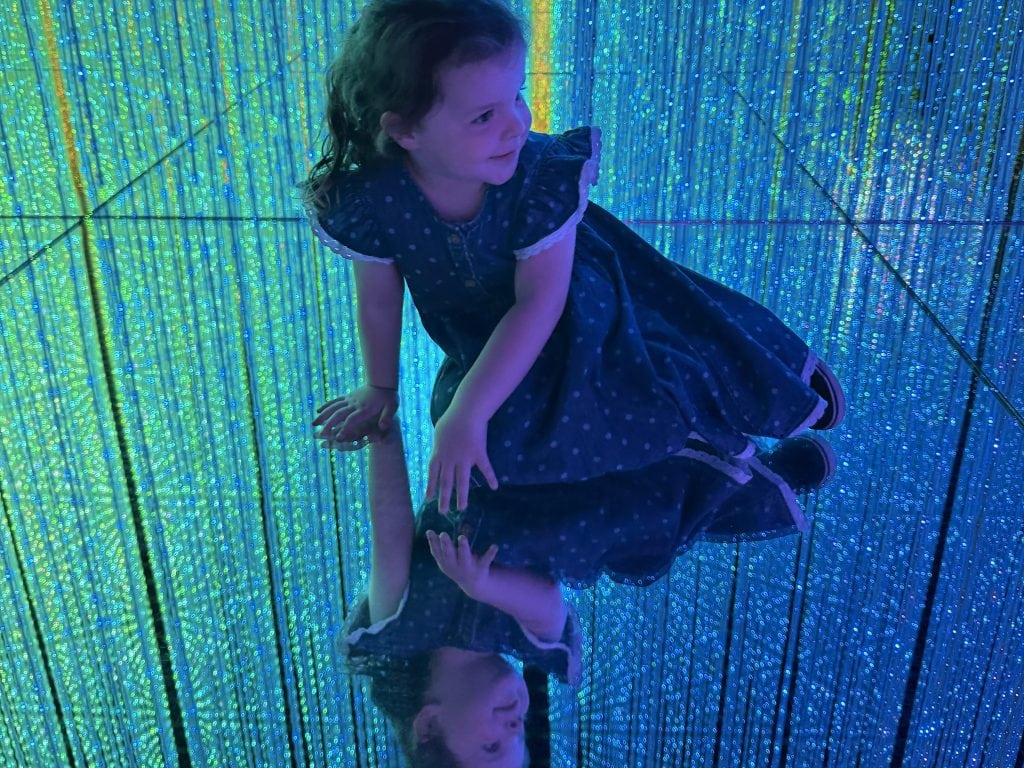
Crystal Universe (the one you’ve seen on Instagram)
This is the most iconic room and easily the biggest crowd-pleaser. We’ve seen a version of the Crystal Universe at all 3 teamLab sites we’ve visited and it never gets old. Think:
- Thousands of hanging LED lights
- Infinite mirror reflections
- Lights shifting colour and pattern around you
You can also interact with it via an app, but honestly, just standing there watching it change is magical enough. Be patient and wait for a quieter moment to get photos without 37 strangers in them.

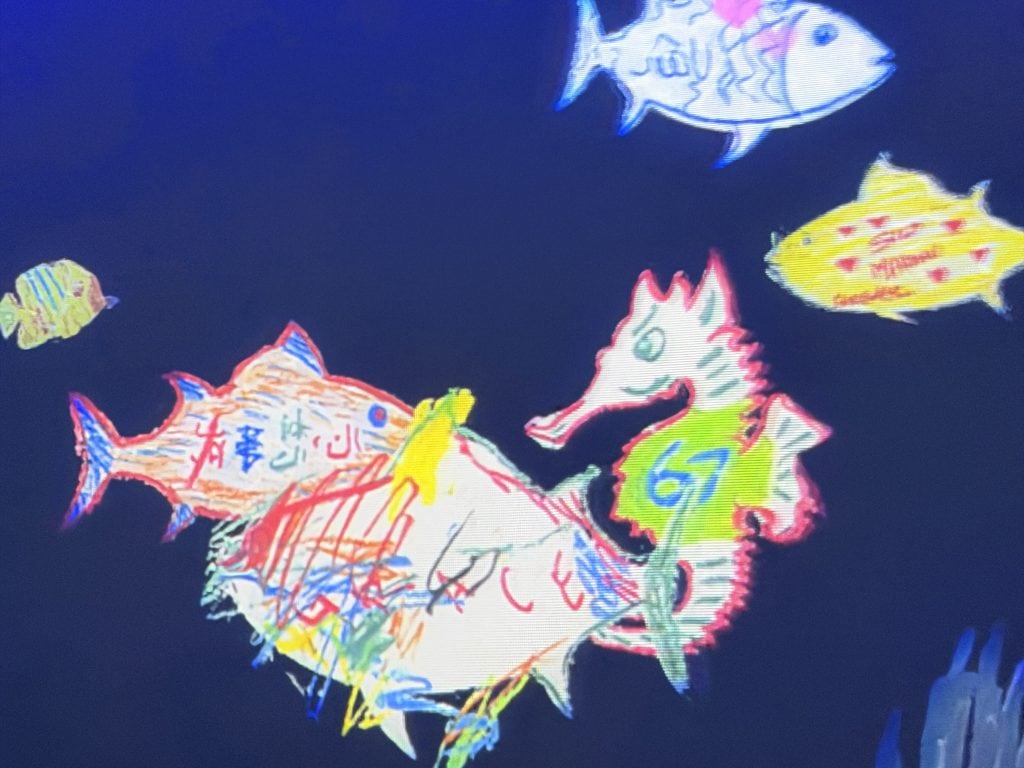
Sketch and Grow / Sketch Aquarium
This is where kids absolutely thrive. Our 3 year old spent the longest amount of time in this exhibit and didn’t want to leave.
- Kids (or you) colour in animals or sea creatures
- They get scanned and appear digitally swimming or moving across the walls
Watching your child spot their drawing come to life is genuinely one of the standout moments of the whole experience. This is less about aesthetics and more about watching your kiddo puff up with a sense of pride as they see their art on display.
Sliding Through the Fruit Field
A surprisingly fun one, especially for little kids who love a playground:
- A mini digital “slide” experience
- Bright fruit visuals that react as kids move through
It’s quick, but it gives kids something physical to do, which helps break up all the walking and staring. You can also go on it again and again, so let the kids run wild.
Interactive projection spaces
The first couple of rooms are full of expansive digital landscapes featuring flowers, animals, or patterns that shift as you move.
These are the classic teamLab Borderless-style installations where everything feels slightly alive. The kids will love seeing the projections on each other as well as the walls. Our baby in the carrier was mesmerised in these rooms.
These are great for wandering slowly while your toddler dances around the room.
Paper aeroplane toss
This exhibit will test your ability to make a paper aeroplane and throw it, but luckily teamLab have provided paper with instructions on how to fold to create a plane.
Once you’ve made the plane, toss it from a platform into a laser vortex and watch the lights as they change.
It’s simple but very effective, especially with kids who are very hands on.

Exhibits that may be tricky with kids
While teamLab Singapore is generally very kid-friendly, there are a few things worth knowing in advance so you don’t end up managing an unexpected meltdown in a dark, mirrored room (been there).
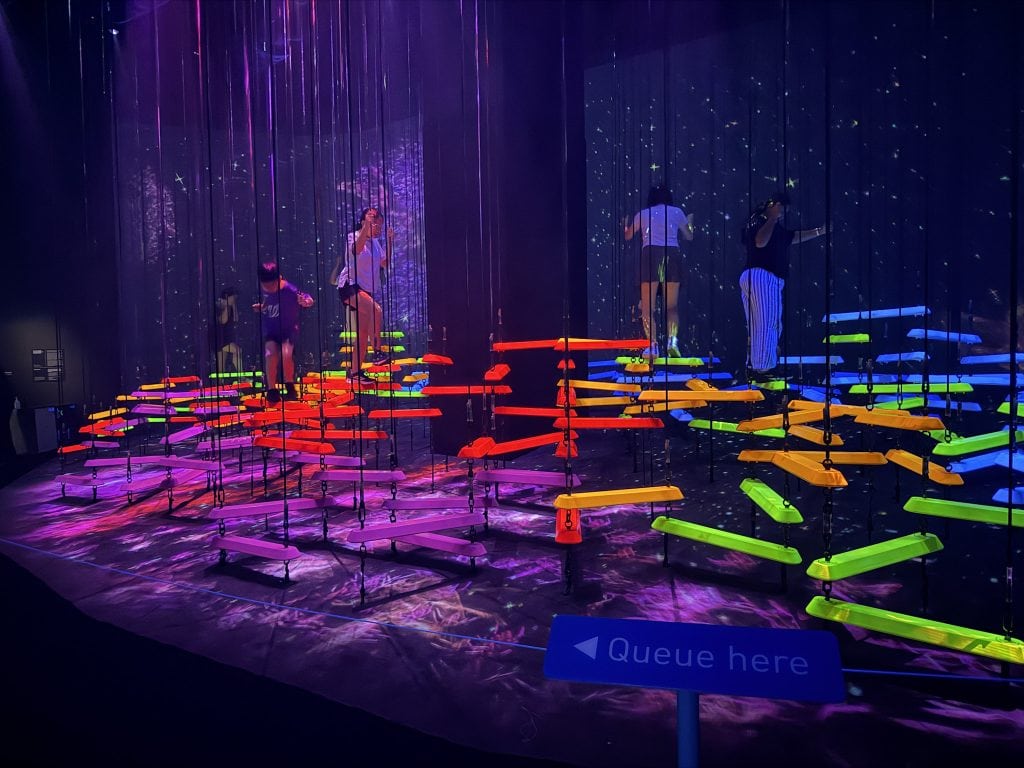
The gym-style exhibit (height restrictions)
This was probably the biggest surprise for us.
There’s an interactive, climbing/play-style installation that looks amazing for kids… but it comes with a height restriction. Unfortunately, our toddler didn’t quite make the cut and was very aware she was missing out.
What made it more noticeable is that the same style of exhibit in Kyoto (Biovortex) didn’t have that restriction, so she had been able to fully join in there. Cue confusion and disappointment when she couldn’t do it this time.
If you’ve got younger kids, it’s worth preparing them in advance or steering them quickly past it before they get too invested.
Dark and mirrored rooms
Many installations are:
- Very dimly lit
- Filled with mirrors and reflections
- Designed to feel immersive and slightly disorienting
For some kids, this is magical. For others, it can feel:
- A bit overwhelming
- Hard to navigate
- Slightly scary at first
Holding hands and moving slowly makes a big difference.
Illusion-style floors and spaces
Some areas have:
- Reflective or mirrored flooring
- Unclear edges or depth perception
Toddlers in particular can:
- Hesitate to walk
- Try to crawl or cling to you
- Suddenly lose confidence (even if they were happily running 10 seconds earlier)
How does teamLab Singapore compare to other teamLab exhibits?
We’ve now officially become those people who plan trips around teamLab (not intentional, but here we are), having visited teamLab Planets Tokyo, teamLab Biovortex Kyoto, and teamLab Future World in Singapore with young kids in tow. So if you’re wondering how Singapore stacks up, here’s the honest take.
teamLab Planets Tokyo (still my favourite)
teamLab Planets in Tokyo was our first teamLab experience, and honestly, the wow factor hit hard. It’s incredibly immersive. You’re wading through water, walking through soft floors, and completely surrounded by art in a way that feels a bit surreal (and slightly chaotic with kids, but in a fun way).
Even now, after seeing others, it still stands out because:
- The sensory experience is next level
- It feels more fully immersive and physical
- The installations are just bigger and more impactful
This is the one that made us a teamLab family in the first place.
teamLab Biovortex Kyoto (the biggest and most diverse)
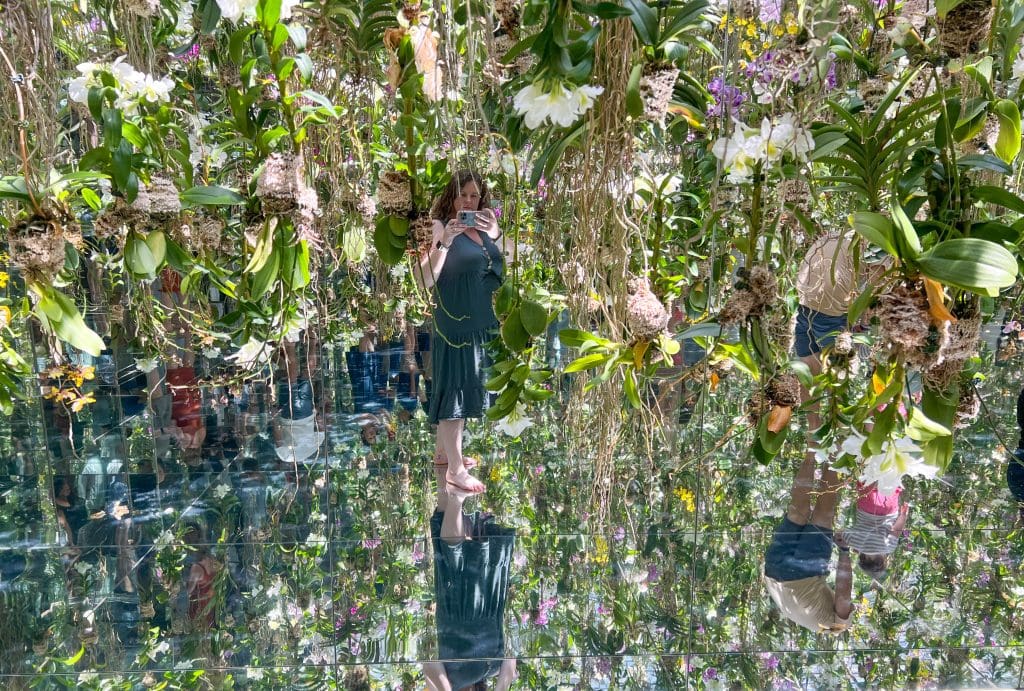
Biovortex absolutely surprised me, mainly because of the sheer size of it. It’s easily the largest teamLab we’ve visited, and it feels like a greatest-hits collection.
What makes it stand out:
- A huge number of installations
- A mix of exhibits from Planets, Borderless, and Future World as well as some unique to Biovortex
- Enough variety to keep both kids and adults engaged for the entire day
If you want scale and variety, this one is hard to beat.

teamLab Singapore (smaller, but still fun, especially with kids)
Singapore’s version is definitely the smallest of the three, and you can feel that pretty quickly. There are fewer rooms, less depth, and it doesn’t quite have the same “completely lost in another world” feeling as the Japan exhibits.
But this is important. It still works. teamLab Singapore is worth visiting, especially when:
- You’re travelling with a restless toddler
- You want something easy, contained, and not overwhelming
- You don’t have 2 to 3 hours to commit to a massive exhibit
It’s the kind of place where kids can run around, interact with everything, and leave happy, which, let’s be honest, is sometimes the real goal.
Final verdict: is teamLab Singapore worth visiting with kids?
So, is teamLab Singapore worth visiting?
For us, the answer is yes… just with the right expectations. It’s not the biggest or most mind-blowing teamLab we’ve done, but it is fun, visually beautiful, and incredibly easy to enjoy, especially with young kids who just want to run, touch, and explore everything in sight.
If you’ve already experienced the larger Japan exhibits, you might find it a little underwhelming. But if you’re travelling as a family or looking for something immersive, air-conditioned, and guaranteed to hold your child’s attention for more than 10 minutes, it absolutely delivers.
At the end of the day, it’s one of those experiences that sits perfectly in a Singapore itinerary. Not necessarily the main event, but a very solid, very enjoyable highlight… and honestly, any activity that keeps a toddler entertained and gets you a decent photo is a win in my books.
FAQs about teamLab Singapore
How long does it take to visit teamLab Singapore?
Most visitors spend 1.5 to 2 hours exploring the exhibits. If you’re visiting with kids or want photos, allow closer to 2–2.5 hours.
Is teamLab Singapore suitable for kids?
Yes, it’s very kid-friendly, especially for toddlers and young children who enjoy interactive, sensory experiences. However, some rooms can be dark, mirrored, or immersive, which may overwhelm more sensitive kids.
Are there any exhibits that might scare young children?
Yes, a few areas feature:
- Dark lighting
- Mirrored floors/walls
- Moving projections around your body
These can feel disorienting for toddlers. Holding hands and moving slowly helps.
Can you bring a stroller into teamLab Singapore?
No, strollers are not allowed inside the exhibition. You’ll need to:
- Park it in designated stroller areas
- Use a baby carrier instead (highly recommended)
Are there baby changing facilities at teamLab Singapore?
Yes, baby changing facilities are available within ArtScience Museum, where teamLab Singapore is located. These are clean and easy to access before or after your session.
Is there a nursing room or space for breastfeeding?
Yes, the museum provides a nursing room suitable for breastfeeding. These are located outside the exhibition, so you may need to step out and re-enter depending on your ticket conditions.
Can you leave and re-enter the exhibition?
Typically, re-entry is not allowed once you exit, as entry is tied to a timed ticket. If you need a break (e.g. for feeding), check with staff before leaving.
What should I wear to teamLab Singapore?
Wear:
- Light, comfortable clothing
- Pants/shorts (avoid skirts) due to mirrored floors
- Flat shoes with grip
Avoid:
- Heels (not allowed in some installations)
- Loose accessories that may reflect or get in the way

Do you need to remove your shoes?
Not entirely, but some installations may ask you to:
- Remove shoes, or
- Wear provided protective covers
This varies by exhibit.
Is it wheelchair or pram accessible?
- Wheelchairs: Yes, the venue is accessible, though some installations may be limited
- Prams: No (must be parked outside)
What’s the best time to visit teamLab Singapore?
- Early morning (first session)
- Weekdays are less crowded than weekends
- Avoid midday peak hours for better photos
Can you take photos at teamLab Singapore?
Yes — photography is encouraged!
Tips:
- Avoid flash
- Use night mode / low-light settings
- Be patient for crowd-free shots
Are tripods allowed?
No — tripods and professional equipment are generally not permitted, as they can obstruct pathways and other visitors.
Is teamLab Singapore air-conditioned?
Yes — it is fully indoors and air-conditioned, making it a great activity in hot, humid, or rainy weather.
Can you bring food or drinks inside?
No — outside food and drinks are not allowed inside the exhibition.
Are there lockers available?
Yes — lockers are available at ArtScience Museum to store bags, prams, and bulky items.
Is teamLab Singapore worth visiting?
For most visitors, especially families and first-timers, yes. It’s a highly immersive, visually stunning experience that feels different from a traditional museum though expectations should be set if you’ve visited larger teamLab exhibitions overseas.
Do you need to book tickets in advance?
Yes — it’s strongly recommended to book tickets ahead of time, especially during:
- School holidays
- Weekends
- Peak travel seasons
How early should you arrive?
Arrive at least 10–15 minutes before your time slot to allow for entry and orientation.
Subscribe for more mum tips for Singapore straight to your inbox
Like this post on whether teamLab Singapore is worth visiting with kids?
Pin to save it for later!