
Baby sleep when travelling: hotel cots, portacots & naps on the go
If there is one thing that makes parents hesitate before booking a trip, it is sleep. Not their own, but their baby’s. As a mum of two kids aged three and under, I can safely say that baby sleep when travelling gives me almost as much anxiety as surviving a long-haul flight with a baby and toddler in tow!
But should it stop you from packing up and seeing the world with your kids? No way.
When you are finally in a rhythm at home, the idea of packing it all up and trying to recreate sleep somewhere new can feel overwhelming. Will the hotel cot be safe? Should you bring your own portacot? What happens if naps only happen in the pram? And will everything fall apart when you get home? Sometimes you need a plan B, C, D and so on.
I have been there. More than once. With two kids who are not the greatest sleepers.
This post is not about perfect sleep or strict schedules. It is about what has worked for us when travelling with a baby, what I stress less about now, and the decisions that genuinely made travel easier. If you are planning a trip and worried about baby sleep away from home, I hope this helps you feel more confident.
Baby sleep when travelling: what matters most
The biggest shift for me when travelling with a baby was accepting that sleep does not need to be perfect. It just needs to be safe, familiar enough, and workable for the stage you are in.
Travelling will always change sleep slightly. Bedtimes can be later, naps might move, and routines bend. There will be evenings when not all kids are in bed by 7pm and that is OK. That does not mean sleep is ruined or that you should not travel. It simply means sleep looks different for a short period.
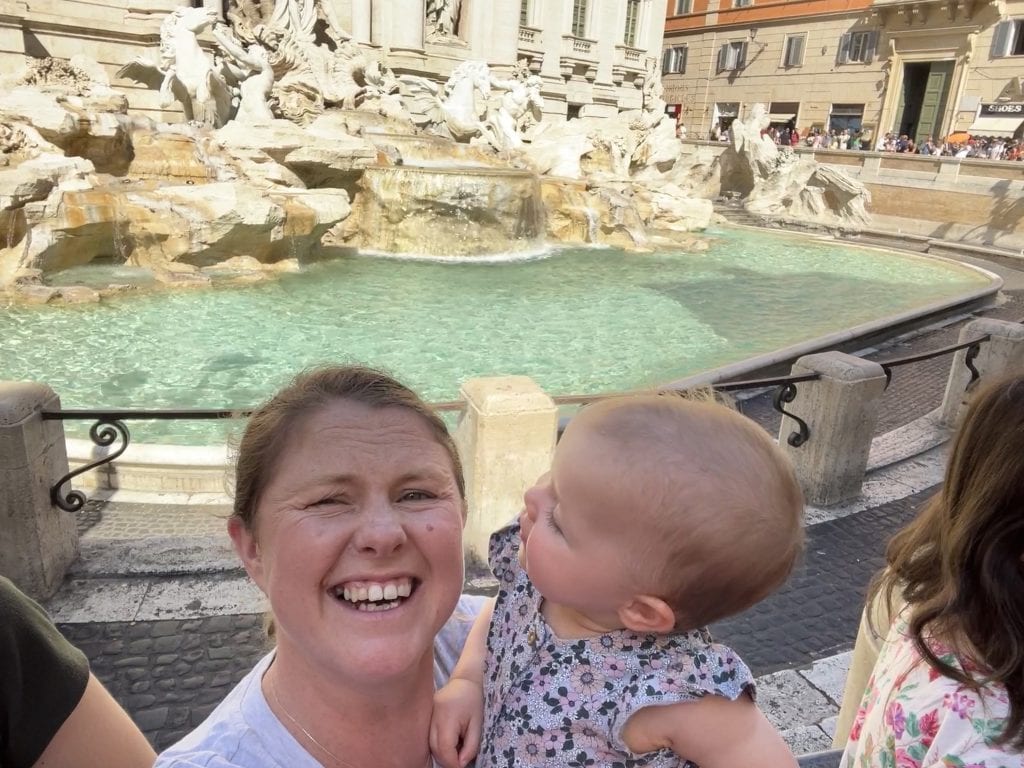
A real life example was when we travelled to Rome with a baby of 11 months, we found the earliest dinner seating at the nice Trastevere restaurants was around 7.30pm. So, we had to improvise, adding an extra nap at the end of the day so that our baby could get through dinner without falling asleep in her pasta!
The things that matter most when travelling with a baby are familiarity, safety, and flexibility. Everything else is optional.

Hotel cots vs travel cots: what is better when travelling with a baby
This is the decision most parents get stuck on and the one that has given me the most stress over the years. Should you rely on a hotel cot, or bring your own travel cot or portacot for peace of mind?
There is no single right answer. The best option depends on your baby, how you are travelling, and how important familiarity is to their sleep.
For some families, hotel cots work perfectly well. For others, bringing your own travel cot is the difference between everyone sleeping and nobody sleeping.
As a general rule we have used hotel cots when we’ve had to fly so that we can avoid checking an extra piece of luggage. But on a driving holiday, we’ve always taken our own portacot. We’ve always contacted the hotel in advance to check that a cot is available and what sort of cot it is so that we can make an informed decision.
Using a hotel cot when travelling with a baby
Many hotels offer cots, especially larger hotel chains and serviced apartments. These can be a great option when flying internationally or when you want to pack lighter.
A few things to know about hotel cots:
- They are usually limited in number, so it is important to request one as soon as you book and confirm again closer to arrival.
- Quality varies widely. Some are sturdy full‑sized cots with firm mattresses. Others can feel more like compact folding cots with very thin mattresses. I always bring a fitted cot sheet as most hotels don’t have cot-sized fitted sheets and just provide a flat sheet which is less safe.
- I also find that hotels provide all sorts of random things for the cot like pillows and quilts – none of which are technically sleep-safe. I just remove all the unnecessary items and pop my baby in the empty cot in the same sleeping bag that they use at home.
- What helped us make hotel cots work better was bringing small familiar extras. A fitted cot sheet that smells like home, our normal sleep sack, and portable white noise made a huge difference. These items are light to pack but add a strong sense of familiarity.
Obviously the biggest advantage to using a hotel cot is that you can pack a little lighter and babies may feel a little more familiar in a cot they’re used to. The disadvantage is you can never be 100 percent sure on the cot’s quality until you arrive and see it in person. However, there is a way to be a little more confident:
Mum tip: always contact the hotel in advance to request a cot AND ask them to provide you the make and model of the cot. We usually also ask for a photo of the cot. This helps us to decide whether the hotel-provided cot will be a safe space for our baby to sleep in or whether we need to bring our own.
For example, when we visited Tokyo with our baby and toddler, we knew the hotel had a wooden, raised cot that was only suitable for a baby under 12 months old. Obviously fine for the baby, but we needed to make other arrangements for the toddler!
On the other hand, we noticed big differences in cot quality between European hotels, including during our time in Basel with kids, which made familiar bedding and white noise incredibly helpful.
Bringing your own travel cot or portacot
Bringing your own travel cot can feel like a hassle, but for some babies it makes travelling dramatically easier.
The biggest benefits are consistency and safety. Your baby sleeps in the same cot they already know, on the same mattress, with the same setup they use at home or on previous trips. As parents, you also sleep more soundly, knowing your baby is in a sleep-safe space that you trust.
This option can be especially helpful if your baby is sensitive to sleep changes, if you are travelling for longer than a few nights, or if good night sleep is a major factor in everyone enjoying the trip.
Things to consider when bringing your own portacot:
- Weight and size matter, especially if you are flying. Some travel cots are designed specifically to meet airline baggage limits.
- Most airlines will allow you to check a portacot and other baby items without it counting towards your luggage allowance. Check the airline’s policy before you fly.
- Ease of setup is important. If a cot is frustrating to put up, you will resent it quickly. And there’s nothing worse than struggling with a difficult cot set up AND a tired baby who needs to sleep. Our Bugaboo Stardust literally unfolds and clicks into place immediately, which we love.
We found that owning a good travel cot paid off quickly because we could use it repeatedly on trips rather than relearning a new setup each time.

Best portacots for travelling with a baby
I always recommend choosing a travel cot based on how you actually travel.
If you fly frequently, look for a lightweight travel cot designed for air travel that packs into a compact carry bag.
If you mostly do road trips, weight may matter less than sturdiness and ease of setup. And of course, whether it fits in the boot of your car.
When choosing a portacot, I look for:
- a firm, breathable mattress
- quick and frustration‑free setup
- a carry bag that is genuinely practical
- good airflow and visibility
- light enough to carry easily, but sturdy enough to withstand flying
- size when set up and packed down. You want it to be roomy for your baby to sleep, but compact when packed down.
A well‑chosen travel cot can become one of those baby purchases that you use more than you ever expected.
Some of our favourite travel cots are:
- Bugaboo Stardust – this is the one we use religiously
- Travel Cot Light by Baby Bjorn
- UPPAbaby Remi Portable Travel Cot
- Nuna Paal Travel Cot

Choosing accommodation that works for baby sleep
When travelling with a baby, accommodation matters more than just about anything.
If your baby sleeps light or you value downtime in the evening, accommodation with a separate bedroom can be a game changer. Apartments, hotel suites, or studio layouts with a sleeping nook allow you to put your baby down and still move around without whispering in the dark. My Melbourne for Minis guide runs through some great family friendly options for Melbourne CBD.
If room sharing works well for you, a standard hotel room can be completely fine. In that case, blackout blinds, white noise, and thoughtful cot placement can make a big difference.
You might also want to consider the Slumber Pod, which is a tent-like cover for the cot, which can function a little like a seperate room for baby. This is a great option for those who can’t afford an apartment or hotel suite.
We’ve done both and to be honest, I’m firmly in the camp of seperate sleep areas for kids and adults. When I’m on holiday, I don’t want to go to bed at 7.30pm. Instead that’s the time for my partner and I to wind down with a couple of drinks and enjoy the views from the hotel window.
Of course, with very little babies, same room sleeping is always recommended and it just makes sense because you’re up throughout the night anyway.
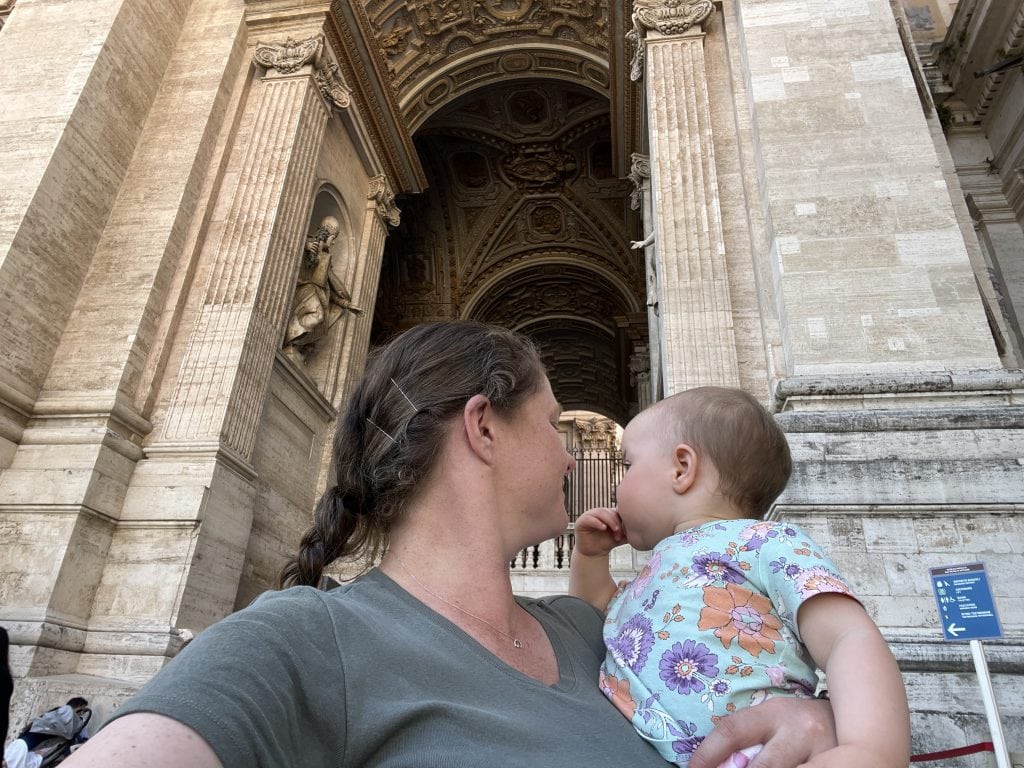
This approach became especially important when we were travelling Europe with a baby, including our time exploring the Vatican with kids, where our apartment accommodation made a huge difference to sleep for us all.
Things I always look for when choosing accommodation now:
- space to comfortably fit a cot
- good block‑out curtains or the ability to create darkness
- clear photos of the room layout – i.e. does it have a door on the bedroom?
- room away from elevators so that you don’t have noise from other people waking up your baby
- is there space for my baby to have a play on the floor in our downtime?
- Proximity to restaurants so that we don’t have a long commute back after a late night
Separate sleep space vs room sharing when travelling with a baby
Some babies sleep happily in the same room as their parents. Others wake more easily when they hear movement or lights. This particularly happens as the baby gets older and more alert. I’ve found that up to 4 months, our baby could literally sleep anywhere. Once she hit 4 months, that freedom was all over.
If you know your baby struggles with room sharing, it is worth prioritising accommodation that offers separation. It may cost a bit more, but honestly if you and your baby haven’t slept well then your holiday will be miserable. Look for 1 bedroom suites or aparthotels, rather than a basic hotel room. This often matters more than luxury or views, though all 3 are always welcome!
If room sharing works fine, lean into it. Keep evenings simple, use noise to your advantage, and accept earlier nights if needed.
Both approaches are valid and you just need to do what is right for your family.
Naps on the go while travelling with a baby
Naps on the go are one of the great gifts of travelling with a baby.
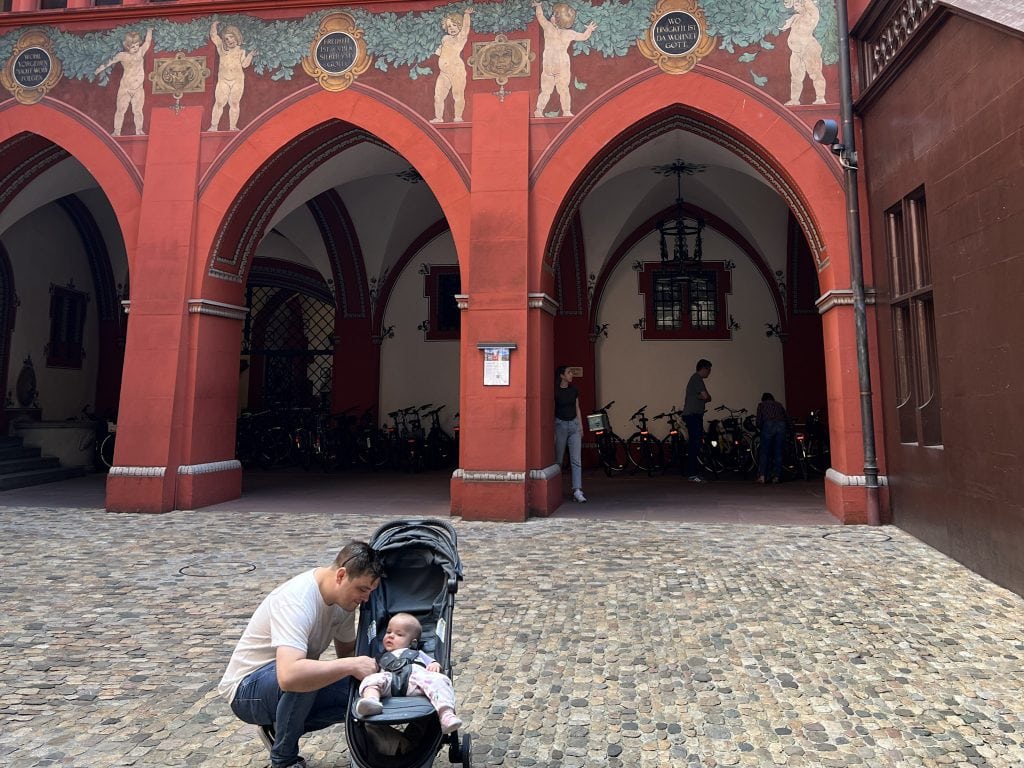
Prams, baby carriers, cars, and even planes can all become nap spaces while travelling. These naps may not always be as long or predictable, but they often allow you to do much more without disrupting the day completely.
Pram naps work well in walkable cities. Carrier naps are fantastic for uneven streets, crowds, and sightseeing. Car naps can be a lifesaver on day trips.
Planning one main activity per wake window rather than over‑packing the day made naps feel far less stressful for us.
Flexibility is everything when it comes to naps away from home. Instead of watching the clock, I now think in terms of rhythm. Enough sleep across the day. Enough downtime. Enough calm.
We relied heavily on pram and carrier naps while travelling, especially during our trip to Osaka with a toddler, where flexibility really mattered.
Some days that means a long pram nap and a late bedtime. Other days it means two short naps and an early night. Both are fine.
The routine often resets naturally once you return home.
Baby sleep packing list for travel
These are the sleep items that consistently earn a place in our bags:
- Sleep sack used at home. Bring a couple of different options for different temperatures.
- Portacot (if applicable). I will always recommend the Bugaboo Stardust.
- Pyjamas. Definitely pack a few pairs in case of blowouts or vomit. Bonds Zippysuits are great.
- A fitted cot sheet. Always handy as most hotels just give you a flat sheet for the cot.
- Portable white noise. Able to be used overnight and on the go. Make sure you bring batteries!
- Baby monitor if helpful – we honestly haven’t bothered with one beyond 6 months.
- Dummy or pacifier if used
- Blackout blind solution if accommodation is uncertain. We use Tommee Tippee.
- Consider the Slumberpod if baby will be in your room overnight.
- Baby carrier for naps on the go
- Travel pram with a decent recline for napping during the day. Our Baby Jogger has a lie flat recline which really helps our bub know its time for sleep. It has done many nap-time miles through the Vatican, Tokyo, Rome, Puglia, Osaka, Switzerland, Malta, Singapore and Kyoto to name a few.

What I’d stress less about
I stress less about recreating home exactly.
I stress less about perfect nap timing.
I stress less about temporary regressions.
I focus on safe sleep, familiar cues, and getting through each day with enough rest for everyone.
Travel with a baby is not about doing it flawlessly. It is about being adaptable, kind to yourself, and remembering that one unsettled night does not undo everything.
Final thoughts on travelling with a baby and sleep
Sleep away from home will never be perfect, and it does not need to be.
With the right setup, realistic expectations, and a bit of flexibility, baby sleep when travelling becomes manageable rather than something to fear.
The more we travelled, the more confident I became. Not because everything went smoothly, but because I knew we could adapt.
If sleep is the only thing holding you back from booking the trip, I hope this helps you feel a little more ready.
Baby sleep when travelling FAQs
Should I bring a travel cot when travelling with a baby?
It really is dependent on your baby, your travel style and what will make you most comfortable.
Do hotels provide baby cots?
Many do, but quality varies. Always request one in advance and bring familiar bedding where possible.
Is it safe for baby to sleep in a hotel cot?
Generally yes, but always check stability and mattress firmness on arrival.
Are naps on the go ok while travelling?
Absolutely. Pram and carrier naps are often what make travel possible with a baby.
Will travelling ruin my baby’s sleep?
Short answer: no, not forever.
Travel can temporarily change sleep, but it does not undo healthy sleep habits long term. Babies are adaptable, and most routines settle back into place within a few days of returning home. What matters most is consistency where you can, not perfection while you are away.
Should I keep my baby’s normal bedtime when travelling?
If you can, great. If not, it is okay to adjust.
Later bedtimes, especially when sightseeing or dealing with time zone changes, are very normal when travelling. I focus more on total sleep across the day rather than clock‑based bedtimes. Once you are home, most babies naturally drift back into their usual rhythm.
Is it better to book accommodation with a separate bedroom?
It depends on how your baby sleeps.
If your baby wakes easily when you move, talk, or turn lights on, a separate sleep space can make evenings far more relaxed. Apartment‑style accommodation or hotel suites often work well here. This is hands down the option we always choose.
If your baby sleeps well in your room, standard hotel rooms can be completely fine, especially with blackout curtains and white noise.
This is one of the biggest quality‑of‑life factors when travelling with a baby, so it is worth prioritising where possible.
Can I use my baby monitor when travelling?
Yes, many parents do. Some monitors work easily abroad, while others depend on local Wi‑Fi or country compatibility. If you rely heavily on a monitor at home, it can be comforting to bring one that works without WiFi.
This is not something that we personally use when travelling with a baby. I have found that being close by and regular checks has worked well enough for us. My kids let me know when they’re awake in the middle of the night!
How do you manage baby sleep on long travel days?
Long travel days are usually about survival rather than structure.
We aim for naps wherever they happen naturally. Pram naps, carrier naps, car naps, and plane naps all count. I lower expectations for sleep quality and focus on keeping everyone calm and fed.
Good sleep usually returns once you settle into accommodation.
Should I bring my baby’s bedding from home?
If you have the space, yes.
A fitted cot sheet and sleep sack that smells familiar can make a big difference. This is especially helpful when using hotel cots or unfamiliar mattresses.
What if my baby sleeps terribly while travelling?
This happens, and it does not mean you have failed. When I was just in Singapore, I think my 5 month old baby woke up about 8 times a night on three out of the six nights we were there. It was so hard.
Some babies struggle with change, stimulation, or different sleep environments. Some just aren’t good sleepers to begin with, like my second child! If sleep is rough, I simplify everything else. Shorter days, earlier nights, fewer plans.
Does baby sleep get easier with travel over time?
Yes, usually. The more babies experience new environments, the more adaptable they often become. Parents also get better at recognising what matters most and what can be let go.
Confidence grows with each trip, even imperfect ones. The next challenge comes when your baby no longer sleeps in a cot and can get themselves in and out of a bed!
Is it worth travelling if baby sleep feels stressful?
Only you can answer that.
But I will say this. For us, the positives of travelling with a baby far outweighed the harder nights. Memories, confidence, and shared experiences mattered more than sleep disruption. And honestly, if you’re not getting much sleep at home with a baby, then why not at least be tired somewhere exciting?!
Like this post on baby sleep while travelling?
Pin to save it for later!