
Surviving a long-haul flight with a baby or toddler: what actually works

I’ve flown many a long-haul flight with a baby, and again with a toddler and a baby. This means I’ve done both the “this isn’t so bad” flight and the “why did we choose this life” one.
I’ve had a delightful sleepy lap baby on a flight from Singapore to Helsinki and a toddler who screamed for ten hours straight instead of sleeping on an overnight flight to Tokyo (so much so that the cabin manager offered to call an onboard doctor) and everything in between.
On one unforgettable flight, my toddler knocked over my one long-awaited glass of wine and soaked my pants. Had I packed spare clothes for myself? Of course not. I had multiple outfits for them, emergency snacks, and backup nappies but for me? Wine‑soaked jeans and regret.
That pretty much sums up a long‑haul flight with a baby or toddler.
They’re rarely easy, sometimes chaotic, but completely doable with the right mindset and a bit of preparation. This post is about what actually helps when you’re flying very far with very small people so you can arrive with your sanity (mostly) intact.
Before you fly: How to prepare for a long‑haul flight with kids
I firmly believe that a long‑haul flight with a baby or toddler is won (or at least made tolerable) before you get anywhere near the airport. I’m not talking rigid planning, but rather anticipating the ‘what ifs’ and having realistic expectations.
Choosing the best flights for a long‑haul trip with a baby or toddler
If you have flexibility, use it, but don’t stress if you don’t. There is no “perfect” flight time when doing a long-haul flight with a baby, only better and worse and every kid is a bit different. It can also change depending on their age.
For example, I’d much rather take my breastfed baby on an overnight flight because I know if I keep her nursing she will sleep for the majority of the flight. The toddler on the other hand will not sleep, so a day flight is always best for her.
- Day flights can work well if your child naps on the go and is generally chill when tired. They’re also best for crazy toddlers like mine who will refuse to sleep inflight.
- Overnight flights sound appealing in theory (“they’ll sleep!”) and sometimes they do. Babies are usually great on these flights if they’re good night sleepers. Nursing mums – your magic milk will usually keep them placid. Other times… they don’t, and you’re awake all night with them.
- Direct flights are almost always worth it with young kids. One long stretch is usually easier than adding a connection with more takeoffs, landings and overstimulation. The one exception to this rule for us is flying from Australia to Europe where the direct flight time is around 18 hours. At that length, we’re going to break up the journey with a stopover in Singapore.
Seat selection on long‑haul flights with babies and toddlers
Seats matter more on long‑haul flights than short ones, not because they’ll magically fix everything, but because small comforts add up over 10+ hours. Whatever you do, don’t leave your seating to chance when taking a long-haul flight with a baby!
Bassinet seats on long‑haul flights: what to know
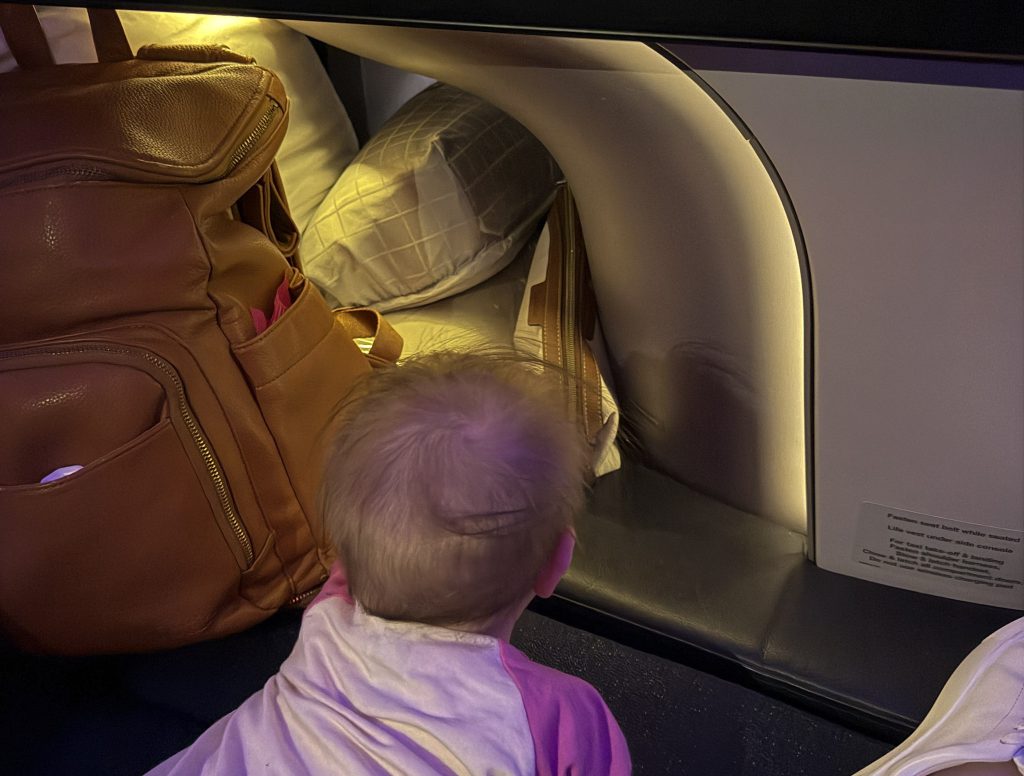
If you’re flying with a young baby, book bassinet seats early if you can. They offer extra space and a place to put baby down if your baby fits and tolerates it. Treat bassinets as a bonus, not a guarantee, and you’ll avoid disappointment. Airlines can vary, but generally your baby will be suitable for the bassinet if they weigh under 10kg. And even if your baby won’t tolerate the bassinet, the extra room at the bulkhead is very handy – especially with nobody reclining in front of you.
Lap infant vs booked seat on a long‑haul flight
Lap infants are common on long-haul flights. It saves money, but it’s physically demanding. If you’re on a long flight and can afford a seat, having that extra space can make a huge difference even if your child still ends up on you. If you want to really ensure maximum rest, you may be able to bring a car seat onboard for your infant to sleep in – you’ll need an airline approved car seat, give advance notice to the airline and you’ll need to purchase an additional fare for the extra seat.
If you can’t afford to pay for the extra seat, it still can’t hurt to ask the airline staff if there’s a chance of them blocking a row with an extra seat for your family at the airport.
Where toddlers sit best on long flights
Window seats can help toddlers focus and rest, while aisle seats are great if your toddler needs frequent movement (or bathroom trips). What matters most is choosing a spot that matches your child’s personality, not what travel forums say worked for someone else. Our toddler loves the window seat and hates when the cabin crew makes her put the shade down!
Packing for a long‑haul flight with a baby or toddler
If there is one universal truth about flying long haul with kids, it’s this: you’ll pack too much of the wrong things and still forget something important. The goal isn’t perfection. We don’t live in a fantasy universe!
It’s packing what you’ll actually use, and learning from past mistakes (like the time I packed half a wardrobe for my child but didn’t pack a single spare outfit for myself… and then wore wine soaked pants for the rest of the flight).
Carry‑on essentials for a long‑haul flight with kids
Your carry‑on is your lifeline. Anything you might need mid‑flight has to be in here. And make sure it is organised. Aeroplanes are notoriously pokey (particularly in the toilets), so there’s no room to be pulling everything out of the bag when you need to do a quick change.
At a minimum, you’ll need:
- Disposable nappies / pull‑ups for the entire flight plus extras. My baby has been known to do 3 consecutive poops in the space of an hour – don’t be caught short! And no cloth nappies please. On a flight, you want to put a dirty nappy in the bin and never look back.
- Wipes (they fix more things than just nappies)
- Changes of clothes for your child. For a flight 10+ hours, I’d pack at least two. And don’t forget spare undies and socks for the toilet trained kiddos.
- Snacks. Then more snacks.
- Comfort items (dummy, sleep toy, favourite book, sleeping bag)
- Medicine. Pain relief in case of ear pain is always handy. And any other medications your kids normally need. For example, we never travel without steroids for croup for our toddler.
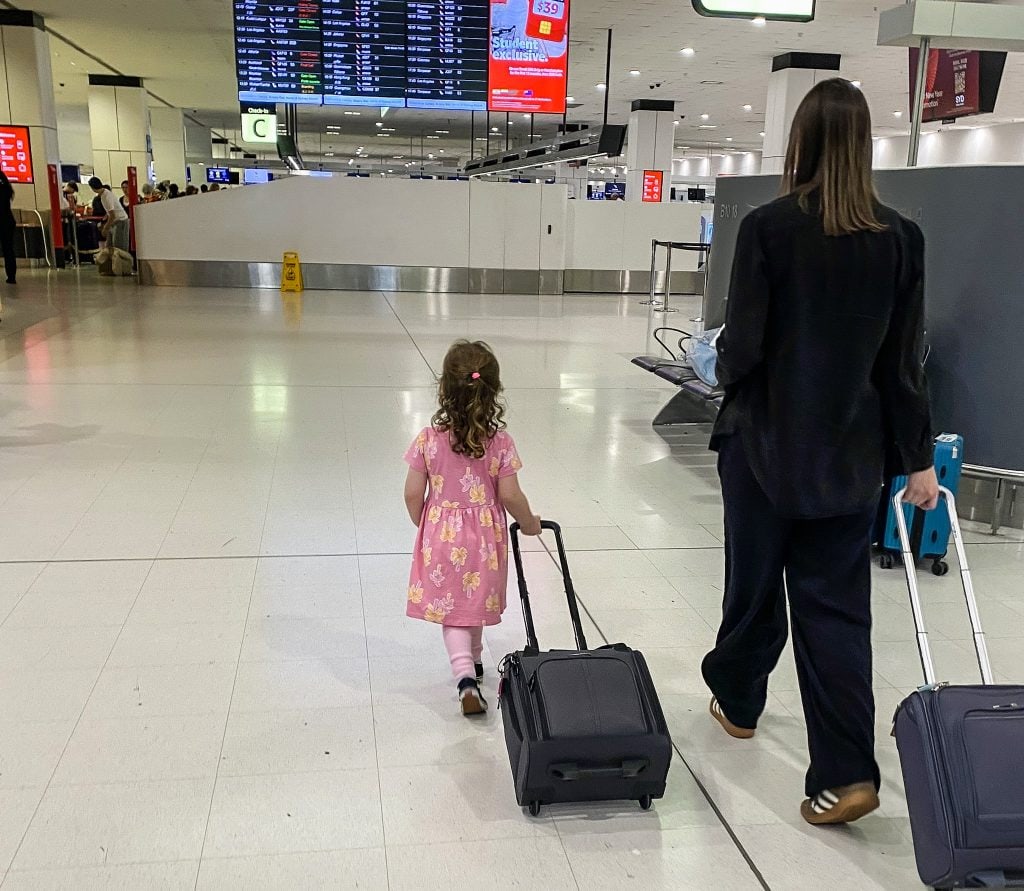
- Travel pram or stroller. Having a travel pram that is able to be taken onboard as carry-on is a gamechanger. After a long-haul flight with a baby or toddler, being able to pop your kiddo straight in the stroller and wheel them through the airport will save your fragile mental state. We love the Baby Jogger City Tour 2 and have always been able to carry it onboard.
And please, learn from my mistakes: Pack a spare top and bottoms for yourself.
Toddlers spill drinks. Babies spit up. Wine will end up where you least expect it. You don’t want to spend 8 hours in damp jeans questioning your life choices.
What to pack for a long flight with a baby
Babies are low‑maintenance in theory and wonderfully unpredictable in practice. A long-haul flight with a baby is no exception to this rule.
Focus on:
- Feeding supplies (more than you think you’ll need). If you’re a breastfeeding mum, thank your lucky stars.
- If your baby is on solids, then a few pouches of baby food and bibs.
- Burp cloths or muslins
- A carrier for hands‑free soothing. We love the Momcozy or the Portier.
- A couple of small, familiar toys (nothing fancy)
- Sleeping bag or swaddle
- A dummy (if applicable). Our first loved her dummy, our second couldn’t stand it.
Babies don’t need much. They need you, food, and some level of comfort. Don’t let the internet convince you otherwise.
What to pack for a long flight with a toddler
Toddlers, on the other hand, require negotiation, novelty, and snacks on rotation.
Bring:
- Small activities or toys you can introduce one at a time. Older toddlers might enjoy a card game like Spot It (small, compact and very easy to play inflight).
- Sticker books, crayons, colouring books
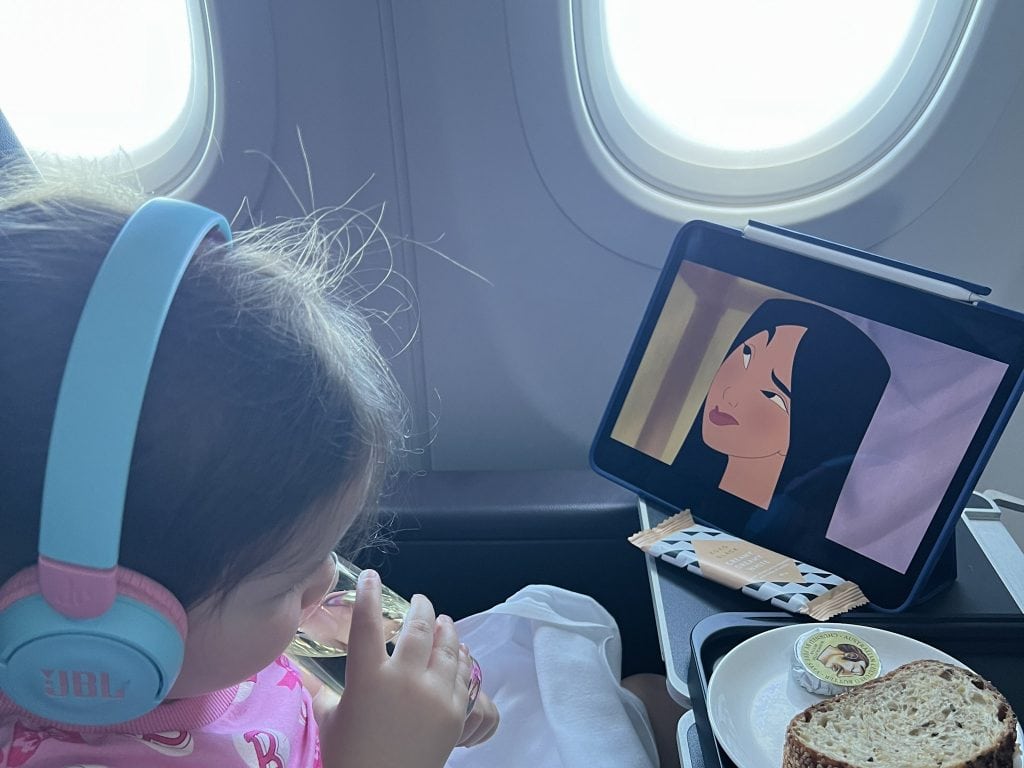
- Headphones that actually fit. We love our toddler’s wireless JBL headphones as the volume is capped at a safe level for little ears.
- Food that can work as a meal in the event your fussy eater doesn’t like the aeroplane food. Croissants, sandwiches and bakery items work well for this purpose.
- Familiar snacks and a few “special” treats
- iPad or tablet (if you have one) with games, movies and audio books loaded up. We were caught out once on an 8 hour flight to Singapore where the inflight entertainment wasn’t working for the entire flight. Luckily we had brought the iPad for the 3 year old or I’m not sure we would have survived.
Think in terms of buying yourself time. Every activity doesn’t need to last long — even 10 peaceful minutes is a win on a long‑haul flight.
The one packing rule I now live by
If it can spill, leak, explode, or be thrown, pack as though it will happen when taking a long-haul flight with a baby or toddler.
Because one day, at 35,000 feet, your toddler will spill your wine all over you… and future‑you will be very grateful you planned ahead.
On the plane: how to make a long‑haul flight easier
Once you’re seated and buckled in, this is where expectations really matter. Forget “smooth flight.” On a long-haul flight with a baby or toddler, aim instead for periods of calm, a few moments of rest, and getting everyone off the plane in one piece.
Managing Sleep on a Long‑Haul Flight with a Baby or Toddler
Sleep on planes is different. It’s lighter, messier, and often happens at odd times — and that’s okay.
With a baby, lean into motion and comfort. Feeding, rocking, or contact naps can work better than trying to recreate the perfect sleep environment. If they nap, great. If they don’t, you’re not doing anything wrong.
With a toddler, drop all expectations of “proper sleep.” A short nap counts. Quiet cuddles count. Sitting still watching a movie half‑asleep absolutely counts. Long‑haul flight sleep is about rest, not routines.
The mindset shift that helps most: any rest is a win.
Feeding, snacks and ear pressure on long‑haul flights
Food fixes more things than we give it credit for.
- For babies, feeding during takeoff and landing can help with ear pressure, but also comfort nerves, overstimulation, and general airplane confusion. A dummy can also do this. For nursing mums, make sure you wear clothes with easy boob access.
- For toddlers, snacks are currency. Rotate them slowly. Save one or two “special” snacks for moments when energy dips or emotions spike.
If you feel like you’re feeding constantly… you probably are. That’s long‑haul flying with kids.
Entertainment tips for a long‑haul flight with kids
This is where buying yourself time becomes an art on a long-haul flight with a baby or toddler.
For babies, small, simple, familiar items work best. Things they already know and love often beat brand‑new toys.
For toddlers, novelty is key:
- Introduce activities one at a time
- Keep a few items hidden for later
- Don’t aim to fill the whole flight — aim to fill the next 15 minutes
And yes…
Using Screens on Long Flights (Without Guilt)
Long‑haul flights are the Olympics of screen‑time exceptions. Screens are tools here, not habits you’re creating forever. If it keeps your toddler calm, seated, and vaguely content, you are winning.
When things don’t go to plan on a long‑haul flight
There will likely be a moment where nothing works. The toy gets dropped. The snack isn’t the right snack. The seatbelt becomes offensive. This is normal.
Take a breath. Change one variable:
- Stand up if you can
- Walk the aisle when allowed
- Switch caregivers if you’re travelling with a partner
- Reset in the bathroom if needed
Sometimes the goal is simply getting through this hour, not the whole flight. You don’t need to entertain nonstop. You don’t need to apologise for your child existing. You don’t need to “win” the flight.
You just need to keep going (snack by snack, show by show, hour by hour) until you land.
And you will land.
After landing: recovering from a long‑haul flight with kids
You’ve landed. You made it. Pat yourself on the back.
But what you do next matters (perhaps even more than the flight itself). The first 24 hours after a long‑haul flight can feel blurry, emotional, and slightly feral, so the goal here is simple: recover gently.
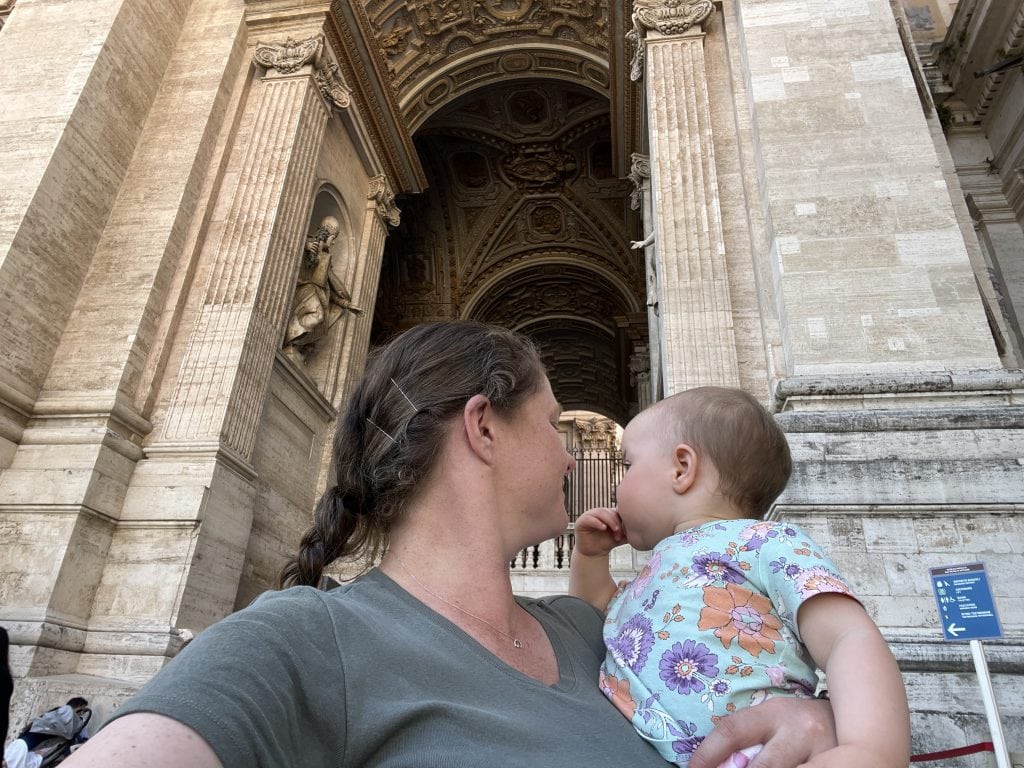
I always recommend allowing a ‘recovery’ day before getting into any sightseeing after a long haul flight with kids. For example, if you’re arriving for 4 days of sightseeing in Rome with a baby, add on a 5th day to reset before you hit the city in earnest.
Another ‘we learned this the hard way’ tip is to not plan for any domestic travel when you arrive. It may seem sensible, after all you’re already at the airport and what’s another hour flight after the long journey you’ve been on.
Your little people will be exhausted and will need to rest – sending them straight onto another flight is not going to go well with tired little bodies.
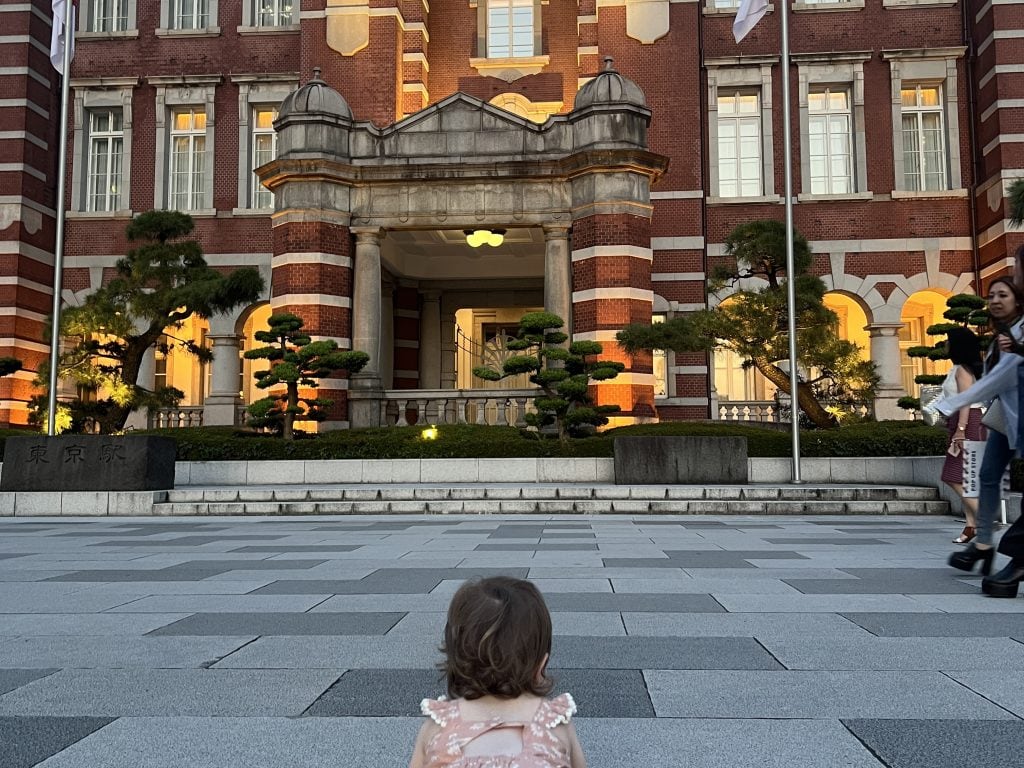
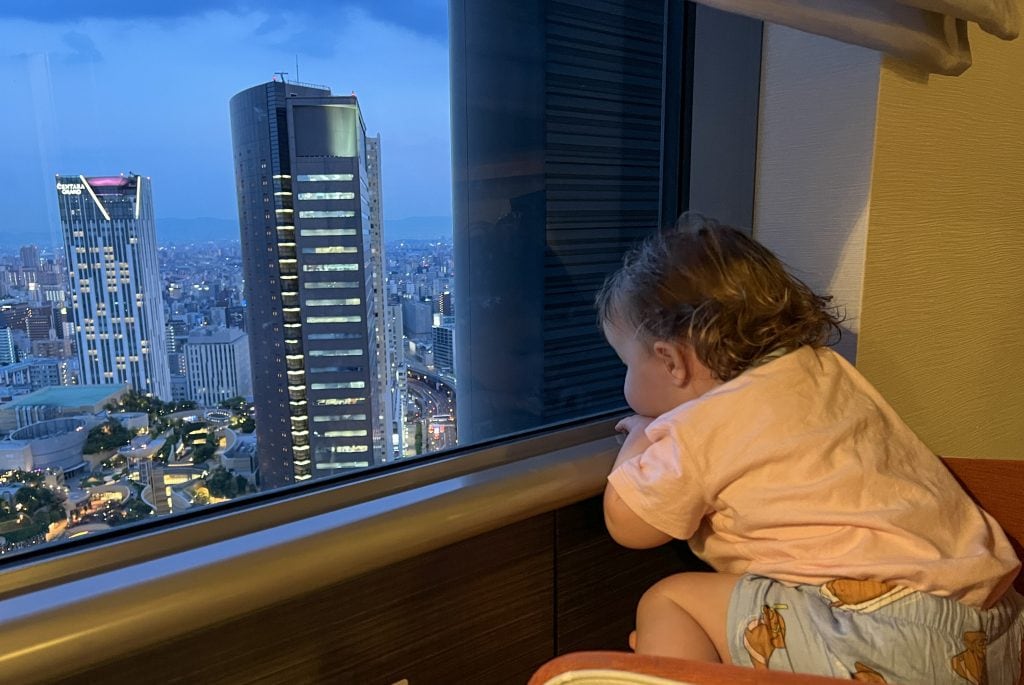
We made this mistake when we landed in Tokyo with a toddler and transferred to a domestic flight after a hellish overnight trip with a 1.5 year old who didn’t sleep for the whole journey. Our time in Osaka with our toddler was amazing, but I’d definitely plan that first day differently if I had my time over.
The first 24 hours after a long‑haul flight with a baby or toddler
As tempting as it is to jump straight into sightseeing, slow down if you can.
Aim for:
- Fresh air and daylight
- Easy food
- Early bedtimes (even if sleep is chaotic)
- Minimal plans
Think reset, not productivity.
Managing jet lag after a long‑haul flight with young children
Jet lag with kids is less about clocks and more about chaos. Tiny bodies take time to adjust, and no amount of Googling is going to make it instant. The good news? There are ways to make it gentler for them and for you.
Lower expectations
Jet lag with kids is normal — and messy.
Expect:
- Strange wake‑ups
- Awkward nap timing
- Extra clinginess or big feelings
You’re not meant to fix everything on day one. You’re meant to get through it.
Use daylight to reset their clock
Fresh air and sunlight are your best tools.
- Get outside as soon as you can
- Even a short walk helps
- Morning daylight works best after eastbound flights
No strict schedule needed — just light and movement.
Keep day one very boring
As tempting as it is to push through, quieter is better.
Aim for:
- Easy meals
- Minimal plans
- Early bedtime (even if sleep is choppy)
Saving energy now makes the next few days much smoother.
Nap strategy: flexibility is key
Sleep will be all over the place.
- Let kids nap
- Try not to let late‑afternoon naps run too long
- Aim bedtime toward local time over a few days
Progress beats perfection.
Meals help too
Food cues the body to adjust.
- Eat at local times
- Snack freely
- Don’t overthink nutrition for a few days
Jet lag is not the time for food battles.
Expect emotional lag
Tiredness often shows up as tears, meltdowns, or clinginess, especially in toddlers. Extra comfort, predictability, and patience help them settle faster.
Don’t forget yourself
You’re jet‑lagged too. Drink water. Eat properly. Shower. Change clothes (especially if you’ve spent a flight in wine‑soaked pants).
One last reassurance
Most kids adjust within 3–5 days, and each day gets easier. The hard part is behind you now and the reason you travelled is finally here.
How long‑haul flights change as kids get older
If you’re reading this in the thick of baby naps or toddler tantrums, here’s the good news: long‑haul flights do get easier. Not all at once, but in noticeable, meaningful ways.
With a baby: physically hard, mentally easier
Flying long haul with a baby is intense in a physical way. There’s a lot of holding, feeding, rocking, and being “on” the entire time. But emotionally? Babies are often surprisingly adaptable. They sleep more, don’t care where they are, and don’t mind being contained as long as you’re nearby.
Hard parts:
- Constant physical contact
- Nap‑trapped arms and stiff backs
- Being needed every second
Easier parts:
- Fewer opinions
- Less boredom
- More flexibility around routines
With a toddler: mentally hard, physically easier
Toddlers flip the challenge. You’re less physically exhausted, but the mental load increases.
They’re alert. They’re curious. They want autonomy but lack impulse control. Sitting still feels unfair. Seatbelts are offensive. They’re constantly hungry. Time moves slowly.
Hard parts:
- Big feelings and strong opinions
- Managing boredom
- Negotiating everything
Easier parts:
- They can communicate
- They eat real food
- They can watch shows and engage with activities
Having done both flights with babies and flights with toddlers, I can definitely say that this is the stage I find the hardest. But don’t let that deter you from taking the flight because the reward is worth it!
Preschoolers and beyond: the turning point
Somewhere around age three or four, something shifts.
Kids start to:
- Understand “later”
- Focus on movies for longer
- Follow basic instructions
- Actually enjoy parts of the journey
They can carry their own backpack. They are better at regulating their emotions. And the whole experience of the long-haul flight is less intense.
Final thoughts: surviving a long‑haul flight with a baby or toddler
A long‑haul flight with a baby or toddler isn’t easy but it is temporary, manageable, and only one small part of the bigger adventure.
With a bit of preparation, flexible expectations, and a willingness to take things one hour at a time, these flights become something you get through rather than something that stops you from going.
You don’t need perfect sleep, calm children, or a polished version of yourself. Just snacks, patience, and the knowledge that this phase won’t last forever. And one day, sooner than you think, the flight that feels daunting now will just be a story you tell to your grown-up kids… hopefully without wine on your pants next time.
Long‑haul flights with a baby or toddler: FAQs
Is flying long-haul with a baby or a toddler easier?
Honestly? Babies are often easier because they nap more and don’t mind being contained. Toddlers, meanwhile, have opinions, energy and very strong feelings about seatbelts. Both are doable, just… different flavours of chaos.
What’s the hardest age for a long‑haul flight?
That magical window when your child can’t be contained but also can’t be reasoned with. Usually around 8 months when they’re on the go until around 2. It will pass. Promise.
Is an overnight long‑haul flight better with kids?
It can be… if your child sleeps well anywhere. If not, it can also be a very long night while the rest of the plane snoozes. Go in hoping for sleep, planning for not much, and you’ll be happiest.
Are bassinets actually worth it on long‑haul flights?
Yes… if your baby fits and tolerates them. But don’t panic if you don’t get one because plenty of babies sleep just fine on a parent or in arms. Think of bassinets as a bonus, not a necessity.
How many nappies should I pack for a long‑haul flight?
More than you think. Then add a few more. Flights get delayed, babies have opinions, and blowouts love altitude.
How do you get a toddler to sleep on a long‑haul flight?
Lower the bar. A nap counts. Closing their eyes for 20 minutes counts. Quietly watching a movie while snuggled counts. Sleep on planes doesn’t look like home sleep, and that’s okay.
Is it okay to use screens the whole flight?
Yes. This is not the time for screen‑time guilt. A long‑haul flight with a baby or a toddler is survival mode, not the parenting Olympics.
What if my baby cries or my toddler melts down?
Then you are officially having a normal flight with kids. Most people understand, the rest don’t matter, and your job is to comfort your child — not manage strangers’ feelings.
Should you walk the aisles with a baby or toddler?
Absolutely, when the seatbelt sign is off. Sometimes a change of scenery fixes everything when taking a long-haul flight with a baby. Sometimes it doesn’t — still worth trying.
Do long‑haul flights with kids ever get easier?
Yes. Slowly, quietly, and then suddenly you’ll realise you watched most of a movie and didn’t panic once. Experience helps. Your confidence grows. And one day, they’ll even carry their own backpack.
Like this post on surviving a long-haul flight with a baby or toddler?
Pin to save it for later!