teamLab Biovortex Kyoto with Kids: Everything You Need to Know Before You Go

There are days when you look at your itinerary and think yes, we are absolutely nailing this parenting thing. And then there are days when you’re standing at a digital art museum in Kyoto, holding a baby on one hip, watching your 3.5-year-old sprint headfirst into a glowing installation while you frantically Google “is TeamLab Biovortex toddler friendly” approximately 20 minutes after you’ve already paid for the tickets.
Spoiler: it absolutely is. But let me give you the version I wish I’d had before we went.
We visited TeamLab Biovortex Kyoto with our baby and our three-and-a-half-year-old, which is to say we visited with one person who wanted to touch everything and one person who also wanted to touch everything but couldn’t quite reach. It was chaotic, it was magical, and at one point involved a minor meltdown in a room full of floating light orbs (the pre-schooler, not me… though it was close).
If you’re planning a trip to Kyoto with kids and wondering whether this one’s worth it, the answer is yes. Here’s everything you actually need to know before you do teamLab Biovortex with kids.
Get itineraries, tips, and honest insights to make travelling with kids feel easier.
Straight to your inbox each week.
What is teamLab Biovortex, Kyoto?
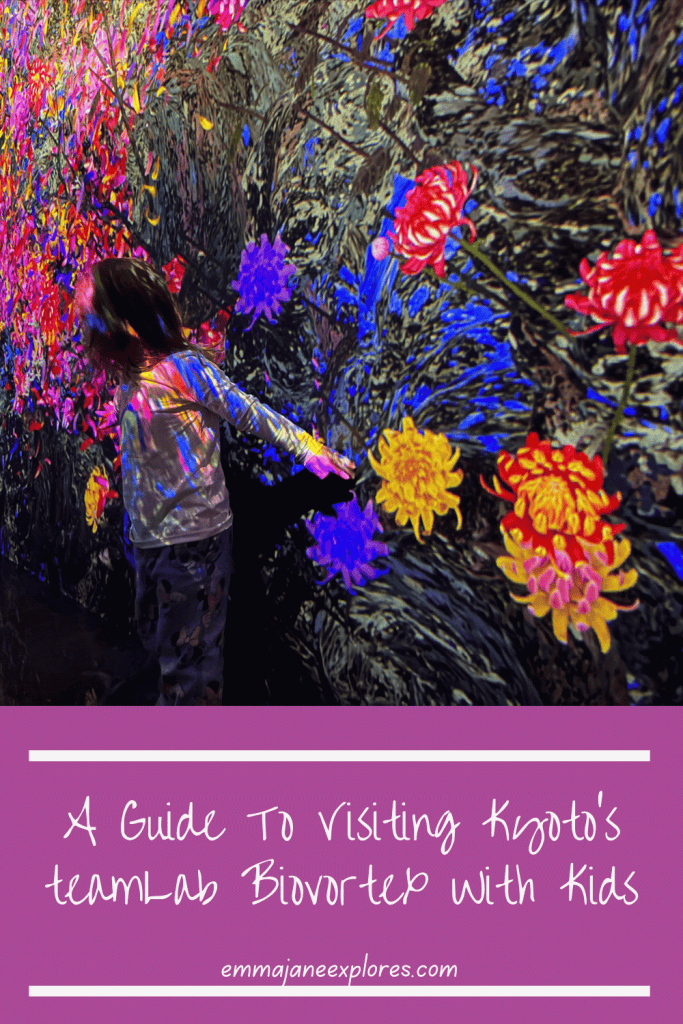
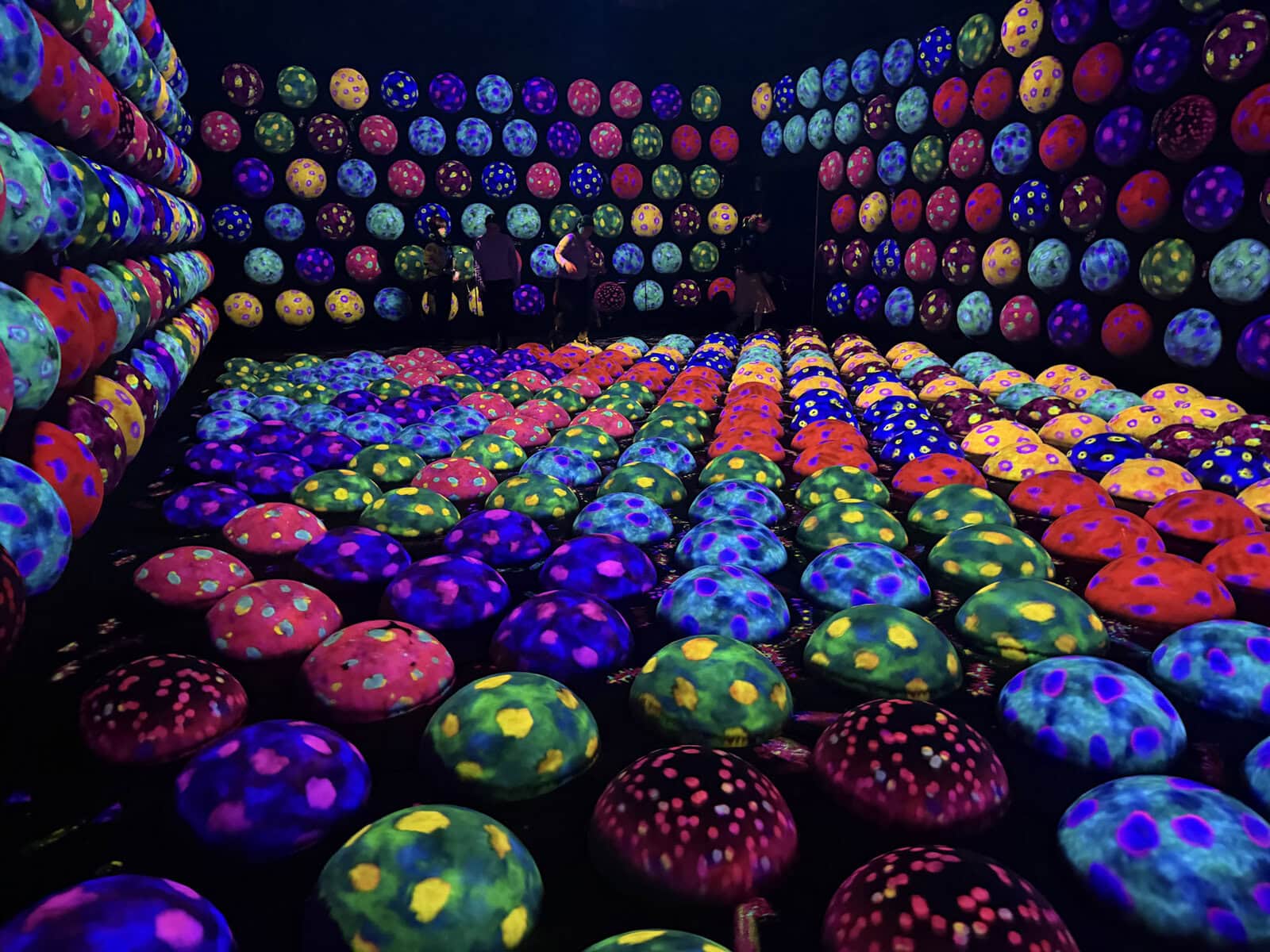
If you haven’t heard of teamLab before, let me introduce you to the rabbit hole you’re about to fall down. teamLab is a Japanese art collective, a wildly talented group of artists, engineers, programmers, architects and designers who create fully immersive digital art experiences where you become part of the art itself.
The installations respond to your movement, your touch, your presence. It’s equal parts gallery, playground and fever dream, and honestly? It’s one of the most genuinely impressive things I’ve ever taken my kids to.
teamLab Biovortex Kyoto opened in October 2025, just a ten minute walk from Kyoto Station, and it made an immediate splash. It’s the biggest teamLab in Japan and spreads across four floors with more than 50 artworks.
Some rooms are calm and ethereal. Others are full-on sensory chaos (in the best possible way). With kids in tow, you’ll experience both ends of that spectrum within about seven minutes.
The museum features pieces making their debut in Japan, alongside popular works from other teamLab exhibits around the world. But Biovortex isn’t just a copy of other teamLab sites. There’s installations here that can only be experienced in Kyoto. So even if you’ve been to teamLab Planets or Borderless in Tokyo, this one genuinely has something new to offer.
If you want to know more about teamLab exhibits around the world, I wrote about our experience at teamLab Future World in Singapore, which is a great starting point.
How different is it from other teamLab exhibits?
The short answer: it’s bigger, newer, and in many ways the best of both worlds.
teamLab Biovortex feels like a blend of teamLab Planets and teamLab Borderless, as if they took the best parts of each and added more. For context, it’s significantly larger than both teamLab Borderless and teamLab Planets in Tokyo combined.
That said, I’ll be honest: teamLab Planets still has a very special place in my heart. There’s something about your first teamLab experience that just hits differently, and that initial wow factor of walking into Planets for the first time is genuinely hard to top.
So if you haven’t been to any teamLab yet, I’d still recommend doing Planets at some point too. But if you’re choosing just one? Biovortex gives you more, and then some.

Is teamLab Biovortex Kyoto good for kids?
Short answer: yes. Enthusiastic yes. The kind of yes where you’re already mentally planning your return visit before you’ve even left.
We visited with our three-and-a-half-year-old and our baby, which I’d describe as the full spectrum of chaos, and honestly? It was one of the best things we did on our entire Kyoto trip. teamLab Biovortex with kids is the perfect way to wear the littles out and give them a chance to let loose, which is something they can’t really do in the more traditional areas of Kyoto.
What age is teamLab Biovortex suitable for?
Children under four get in free, which is a very welcome bonus when you’re travelling with little ones and the costs add up fast. There’s no minimum age requirement either, so technically everyone is welcome from day dot.
That said, the sweet spot is probably toddlers and up. Not because babies won’t enjoy it, ours was perfectly content to sit in the carrier and watch the spectacle, but because so much of the magic comes from realising that you are making things happen.
In many exhibits, your movements are changing the lights, the colours, the sounds around you. A three-year-old who clocks that? Genuinely next level wow factor.
Visiting teamLab Biovortex with a toddler or baby: what to expect?
The single most important practical thing to know before you arrive if you are doing teamLab Biovortex with kids: strollers are not allowed inside. You leave them in the luggage room at the entrance and go in stroller-free.
If you have a baby, bring a carrier. This is non-negotiable advice. Trying to navigate dark, immersive rooms while also managing a toddler with your arms full is not the vibe you want. Carrier on, hands free, sanity preserved.
The museum is mostly dark with dramatic, ever-changing light installations, and a couple of the rooms are genuinely quite intense on the senses. Some kids love this immediately. Others need about thirty seconds to recalibrate before they’re completely sold. When the baby got overwhelmed, we just faced her forward in the carrier to give her eyes a break.
Also worth knowing: there’s no food inside and no café on site. Eat before you go, pack snacks for afterwards, and bring water. Arriving with a hungry toddler is an entirely avoidable problem and one I am very much speaking from experience about.
Our session was from 11am and we were totally unprepared for how long we spent there. When we left at 2.30pm our eldest was hangry and we had a mad dash trying to locate food for her. Thank goodness for Japanese Konbinis.
What are the best teamLab Biovortex zones for kids?
When visiting teamLab Biovortex with kids, you’re hard pressed to find an exhibit that doesn’t appeal. The Athletics Forest and Future Park sections were the standout moments for our three-year-old because you’re truly in the art. Athletics Forest in particular is a full-body, jump-around, climb-everything kind of experience that feels less like looking at art and more like the best playground you’ve ever been to, except everything glows.
But honestly the whole museum is built for curiosity, which means it’s built for kids. Nothing is behind glass. Nothing is off limits except one exhibit that required you to walk through an oily coloured water in gumboots which is only for older people.
Everything responds to you. For any parent who has spent a cultural outing whispering “please don’t touch that” on a loop, walking into a space where touching is literally the point is a very specific kind of relief.

What not to miss at teamLab Biovortex with kids
With over 50 installations across four floors, there is genuinely a lot to see. We spent half a day in here and still felt like we’d missed things. These are the ones worth making sure you don’t walk past.
Infinite Crystal World
You’ll know this one the moment you walk in. Most teamLabs I’ve visited have a version of this installation. Its an endlessly mirrored room of crystals lit up by glowing, pulsing lights that seems to stretch on forever in every direction.
It’s the kind of room that stops you in your tracks, which is very inconvenient when you have a toddler trying to push past you. Genuinely one of the most beautiful spaces I’ve ever stood in, no matter how many times I’ve seen it now.
Athletics Forest
If your kids do nothing else here, make sure they do this. This section is one of the last areas of teamLab Biovortex, so whilst I’m not saying rush through the other installations you want to make sure you have ample time for this area.
It is an enormous physical play space where climbing, jumping and bouncing are not only allowed but the entire point. Adults will enjoy it too, though you may need to fight a small child for a turn on the bouncy spheres.
Our toddler’s favourite… much to my dismay… was the Multi Jumping Universe. Essentially a trampoline race with mystical lighting. Thankfully her Dad took that one for the team.
Future Park and Sketch Factory
The Sketch Factory is an absolute winner with kids old enough to hold a crayon. Children draw their own creatures, colour them in, scan them, and watch them appear swimming around on the walls and floor. Note that the Sketch Factory opens at 11am rather than 9am, so worth factoring that into your timing if it’s on your must-do list.
This is also a great area for babies. I grabbed a quiet patch of carpet and our five month old was able to sit on the carpet and marvel at the projections while her sister ran rings around us all chasing her sketch that had come to life.
Megaliths and Moss Garden
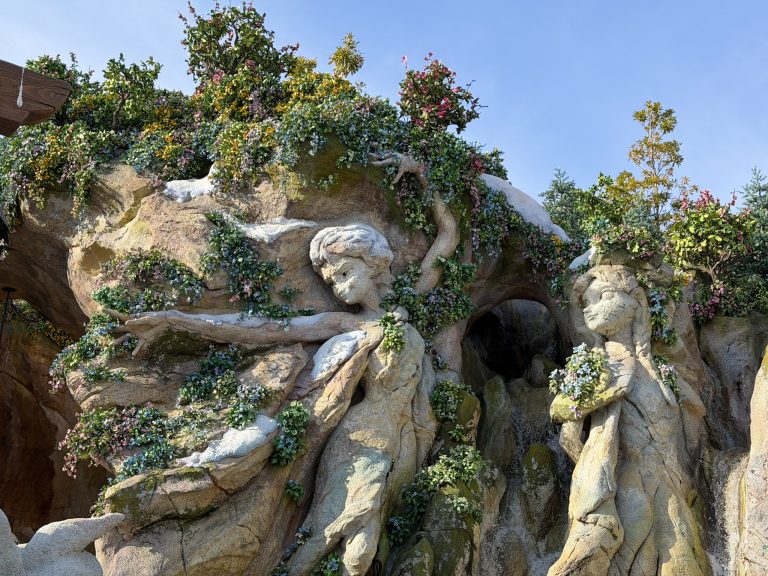
This one stopped us in our tracks, and not just because our three-year-old took one look at the towering glowing rock formations rising out of real living moss and announced it looked exactly like the troll scene in Frozen. She wasn’t wrong.
The megaliths are these enormous structures covered in shifting light and seasonal flowers, surrounded by actual moss, and occasionally real rain falls through the space as part of the installation. There’s even a scent drifting through the air.
It feels ancient and otherworldly and utterly unlike anything else in the museum. Somewhere between a Zen garden and another dimension. The kids were transfixed. So were we.
Forest of Resonating Lamps
Hundreds of hanging lamps that light up and change colour in response to your presence, rippling outward from wherever you’re standing. It feels like something out of a fairy tale, and it’s one of those rooms where everyone goes quiet for a moment because it’s just that lovely.
Our only challenge was keeping our eldest from touching the lanterns. She was so excited because she thought it looked like the lantern scene from Tangled.

Getting tickets for teamLab Biovortex Kyoto with kids
How much do tickets cost?
The good news if you’re visiting with little ones: children under three get in completely free. Which, when you’re travelling with a baby, feels like the universe finally giving you something back after all those extra bags you’ve been lugging around.
For everyone else, pricing works on a dynamic model, meaning it varies depending on the date and time slot you choose. As a rough guide, adult tickets start from around ¥3,400 on weekdays and go up from there, with weekends and public holidays sitting at the higher end. Children aged four to twelve pay ¥1,800, and junior and senior high school students pay ¥2,800. If you leave it until the day and buy on the door, add another ¥200 on top.
Worth doing the maths before you go: for a family with a toddler and a baby like us the free under-three entry makes a real difference to the overall cost. But for bigger families with older kids, it can add up quickly so it’s worth factoring into your Japan budget planning ahead of time.
Where to buy tickets?
Buy in advance through the official teamLab website or through Klook, which is an official ticketing partner and often the easiest option if you’re booking everything for your Japan trip in one place. Tickets come straight to your phone so there’s nothing to print, which when you’re wrangling children is genuinely one less thing to think about.
Should you book in advance?
Yes. Not as a vague suggestion but as genuine advice from someone who has watched people get turned away at popular Japan attractions because they assumed they’d be fine on the day. teamLab Biovortex has been selling out weeks in advance, particularly on weekends and during peak travel seasons like spring cherry blossom season and autumn foliage season.
Weekday morning slots tend to be both cheaper and quieter, which for a visit with young kids is honestly the ideal combination. Book as early as you can, lock in a morning slot if possible, and then you can stop thinking about it and just enjoy being in Kyoto.

Planning your visit to teamLab Biovortex with kids
How to get to teamLab Biovortex
It’s an easy ten minute walk from the Hachijo Exit of Kyoto Station. For anyone staying near Kyoto Station this is genuinely one of the most convenient major attractions in the city, no extra trains or complicated connections required. And then a short walk with toddler in the pram, baby in the carrier – easy peasy.
The proximity to the station also makes teamLab Biovortex an easy day trip from Osaka for anyone basing themselves outside of Kyoto. If you have a JR Pass for Japanese trains, you can get from Osaka to Kyoto free of charge – even better!
How long to spend at teamLab Biovortex
Honestly? Longer than you think. The general consensus is to allow at least three hours, and with kids that’s probably the minimum rather than a leisurely estimate. There are over 50 installations across four floors and no set route, so it’s very easy to lose track of time entirely.
We had an 11am session and were there until 2.30pm and could have happily kept going if it wasn’t for getting hungry. If your toddler gets deep into Athletics Forest, carve out extra time because getting them out again is a whole separate challenge.
Best times to visit teamLab Biovortex with kids
First slot of the day on a weekday is the golden ticket. The museum opens at 9am and that early morning window is noticeably quieter, which with young children makes a genuine difference to the experience. More space to wander, less jostling in the popular rooms, and your toddler gets to run around without you spending the whole time apologising to strangers.
If a weekday isn’t possible, evening slots from around 5pm onwards can also be quieter once the daytime crowds thin out, though that time slot is obviously a challenge for younger kids.
Avoid weekends during peak travel seasons if you can, particularly cherry blossom season in late March to early May and autumn foliage season in November, when tickets sell out fast and the museum gets busy.
One practical note: the Sketch Factory doesn’t open until 11am, so if that’s on your must-do list, factor that into your timing rather than arriving at 9am and spending the first two hours wondering where it is. It is one of the last exhibits in the complex, so unless you race through all four floors I think you’d be fine to book the 9am opening slot and just take your time going through until Sketch Factory opens.
Stroller policy and what to bring
Leave the stroller at the entrance. There’s a free luggage room with secure lockers right at the door where you can store it, along with bags and jackets if you want to walk around unencumbered (which I’d recommend).
If you have a baby, bring a carrier. This is the single most useful piece of advice I can give you for this visit. Trying to navigate dark immersive rooms on four floors while holding a baby and keeping track of a toddler with your hands full is not the experience you want. Carrier on, problem solved.
A few other things worth knowing before you go: wear comfortable shoes and avoid sandals or heels, as you can’t enter Athletics Forest in them. The floors in some rooms are mirrored, so if you’re in a skirt, shorts underneath are a good idea.
Free lockers are available at the entrance, which is handy for storing anything you don’t want to carry around. It’s warm inside, so I recommend taking off jackets and outer layers to keep your hands free.
Re-entry isn’t permitted once you leave, so make sure you’re ready to commit to the full experience before you head in.
What to do near teamLab Biovortex
The Kyoto Station area isn’t traditionally where people spend their sightseeing time, but it’s worth knowing that the surrounding streets have plenty of convenience stores and cafes for a post-visit snack stop, which with two small children you will absolutely need.
The station itself also has a great basement food hall if you want a proper meal before or after. The Cube Food Court on the 11th floor also has great options. Then again, you can always find the nearest konbini and enjoy amazing, cheap food on the go too.

Is teamLab Biovortex worth it for families?
Yes. Genuinely, wholeheartedly, yes.
I’ll be honest with you: I went in with fairly high expectations because we’d loved our previous teamLab experiences, and high expectations in travel can be a dangerous thing. But teamLab Biovortex delivered. Not in a ticking-boxes kind of way but in the way where you come out blinking into the daylight and your three-year-old immediately asks when you can go back.
Visiting with a baby and a toddler is absolutely doable. It’s not the most relaxed afternoon of your life, but it’s far more manageable than you might expect, and the combination of interactive installations, physical play spaces and sheer visual wonder means both age groups are genuinely catered for rather than one of you dragging the other around.
The ticket price may feel significant in the moment, particularly if you’re already deep into a Japan trip budget, but it’s the kind of experience you’ll be talking about long after you’ve forgotten what you spent. And with under-threes getting in free, families with babies and young kids get a pretty good deal.
If you’re visiting Kyoto with kids and wondering whether to fit this in alongside the temples and gardens, my answer is yes. It sits beautifully alongside everything else the city offers, a reminder that Kyoto isn’t just ancient but also brilliantly, unexpectedly modern.
Just book early, bring a carrier, pack snacks for after, and prepare for your toddler to talk about the troll rocks from Frozen for the rest of your trip.

teamLab Biovortex Kyoto FAQs
Can you bring a stroller into teamLab Biovortex?
No, strollers aren’t permitted inside the museum. There’s a free luggage room at the entrance where you can leave it along with any bags or jackets. If you’re visiting with a baby, bring a carrier so your hands are free inside.
How long does teamLab Biovortex Kyoto take?
Allow a minimum of three hours, and more if you have kids who want to spend serious time in Athletics Forest. With young children the pacing is naturally slower, so building in a bit of extra time means you’re not rushing through the installations you’ve been most looking forward to.
What is the best time to visit teamLab Biovortex with kids?
First entry slot on a weekday is the ideal combination of quiet and cheap. The museum opens at 9am and the early morning window is noticeably less crowded.
Is teamLab Biovortex suitable for babies?
Yes. There’s no minimum age requirement and children under three get in free. Babies tend to be fairly mesmerised by all the light and movement, so don’t let having a very young one put you off. Just bring a carrier since strollers aren’t allowed inside.
Are there baby change and nursing facilities at teamLab Biovortex Kyoto?
Yes, we found them in the Athletics Forest section of the complex. There’s a really great parents area with curtained chairs for nursing and change tables. So while my eldest child was busy bouncing herself into blackholes in the trampoline race, I was able to take the baby for a quiet feed without the distraction.
As a general rule when visiting any major attraction in Japan with a baby, it’s worth locating the facilities early in your visit rather than trying to find them in a hurry. I found that Japan is generally excellent for baby facilities so you’re unlikely to be caught out.
Do you need to book teamLab Biovortex tickets in advance?
Yes, and I’d say this one pretty firmly. Tickets sell out regularly, particularly on weekends and during peak travel seasons. Book through the official teamLab website or Klook, aim for a morning weekday slot if you can, and get it locked in well before your trip.
Is teamLab Biovortex Kyoto the same as teamLab Borderless or Planets
Not exactly. There’s some crossover with installations you might recognise from the Tokyo locations, but teamLab Biovortex also has Kyoto-exclusive works you won’t find anywhere else. It’s significantly larger than both Borderless and Planets, and the overall feel is its own thing. If you’ve already done the Tokyo teamLabs it’s still very much worth visiting, and if Biovortex is your first teamLab experience you’re starting at the top.
Is there anywhere to eat near teamLab Biovortex?
There’s no café or restaurant inside the museum itself, so arrive fed or have a plan for afterwards. The good news is that Kyoto Station is only a ten minute walk away and it has one of the best food halls in the city, with everything from ramen to bento to sit-down restaurants across multiple floors.
There are also convenience stores close by for a quick snack fix if you have a hungry toddler who cannot wait the ten minutes it takes to walk to the station.
What else is there to do in Kyoto with kids?
Oh, where to start. Kyoto is honestly one of the best cities in Japan to visit with children. Fushimi Inari is an obvious highlight and kids love running through the torii gates, just go early before the crowds arrive. Arashiyama and the bamboo grove is another one that genuinely stops little ones in their tracks.
For something more hands-on, the Kyoto Railway Museum is a brilliant half day out with toddlers and train-obsessed kids. And if you want to balance all the temples and shrines with something more interactive, teamLab Biovortex fits beautifully into a Kyoto itinerary as your one big modern experience amongst all the ancient ones.
Planning a trip to Japan?
I share real itineraries, practical tips, and honest family travel advice in my weekly emails.
Like this post on visiting teamLab Biovortex with kids?
Pin to save it for later!